

Why Used-Car Prices Are High in India
10 July,2026
Updated:30 September,2026
0 min read

share


Copied
 664
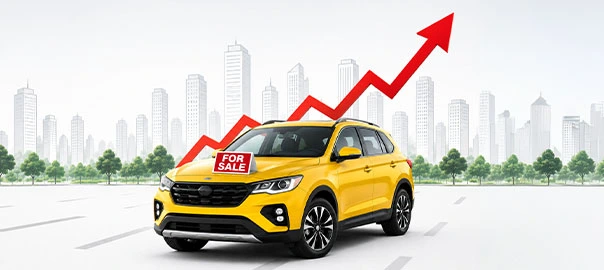
664A three-year-old SUV selling for nearly the price of a brand new compact hatchback would have seemed unthinkable a decade ago. Yet, it has become the standard reality in today’s used-car market in India.
Buyers usually expect steep discounts on pre-owned vehicles, but they’re usually met with strong car resale values. If you’re wondering why used-car prices in India are higher, this blog has the answer. It also shares deep insights into the used-car market in India.
Overview of the Used-Car Market in India
India’s used-car market has evolved drastically over the years. Once dominated by local dealers and informal transactions, this segment has transformed into an organised ecosystem in the past decade. You can credit much of this transformation to the multiple used-car marketplaces that have sprawled over the years. Besides simplifying car searches, these platforms help buyers with pre-vehicle inspections, enabling them to get better deals. It has simplified the process of finding quality second-hand cars and increased their societal acceptance.
As of 2025, India’s used-car market was valued at USD 40.41 billion, and it’s expected to grow at an 11.47% CAGR between 2026 and 2032. It means the used-car market in India will reach a market size of USD 86.32 billion by 2032, which is massive.
The Growing Popularity of the Used-Car Market in India
The used-car market in India has seemingly entered its most popular and growth-centric era. You can confirm it from the fact that used-car sales no longer rely on festive seasons or discount periods alone. In fact, each month accounts for between 6% and 10% of the year’s total sales volume. States like Uttar Pradesh, Gujarat, Maharashtra, Telangana, Karnataka, and Tamil Nadu have reported an increase in used-car sales in 2025 compared to 2024, highlighting the growing popularity of the used-car market in India. While there are several reasons behind this growing popularity, much of it can be attributed to easy financing options, increased social acceptance of used cars, and reliable marketplaces that connect car sellers and buyers.
How New Car Prices Influence Used-Car Prices in India
Whether you’re exploring manual or used-automatic cars in India, you’ll notice their prices fluctuate whenever a new car price is announced. If new car prices are significantly higher, people usually start leaning towards pre-owned vehicles for the cost advantage. This shift in demand for used SUVs and other used cars pushes up vehicle prices, especially for popular models known for reliability and fuel efficiency. You may find a slightly lower resale value for a car during festive or peak-discount periods, when even new cars may be briefly available at a lower price.
What Determines a Car’s Resale Value?
Multiple factors determine a car’s resale value. We’ve listed some of the key factors for your reference –
Vehicle’s Age & Condition
A car’s age matters more than people realise because it influences depreciation. However, the car’s condition matters even more. A well-maintained five-year-old vehicle with a clean service record will command a higher car resale value than a newer car with visible wear.
Brand Reputation & Market Demand
Cars from reputable brands, such as Maruti Suzuki, Hyundai, Toyota, and Tata Motors, usually command higher resale values. You can expect even stronger car resale value if the model enjoys a steady market demand.
Usage Patterns
Much of a car’s resale price is determined by how extensively it has been used. Cars with lower usage patterns are priced higher, while those with higher usage patterns are priced lower.
Service History
A car’s service history shows how well the owner has taken care of it. Many buyers prefer to check the car’s service records to determine whether the price is worth paying. So, naturally, cars with a strong service history have higher resale value, and vice versa.
Features
People are not willing to compromise on features, regardless of the type of vehicle they purchase. The more features a car has, the higher its chances of attracting quality buyers. It also translates to a higher resale value. Hence, if you were wondering why used SUV prices in India are higher than those of other vehicle types, this should answer your question.
Key Checks Before Purchasing a Used-Car: Vehicle Condition, Mileage, & More
Since used cars aren’t always affordable, especially popular models, it’s wiser to evaluate them against multiple factors before making the final purchase. If you’re purchasing a used car in India, conduct the following checks first.
Vehicle Condition
Always inspect the used car thoroughly for any visible signs of accident repairs, rust, paint inconsistencies, etc. In addition to an external inspection, ask the seller for a quick drive test to determine whether the car is in good working condition or has underlying mechanical issues.
Mileage
You should ask about the car’s mileage in the initial discussions. Look for a high-mileage car that hasn’t been used enough if you plan to use it for longer. Cars with low mileage may appear more cost-effective initially, but they aren’t necessarily the best option in the long term.
Ownership & Maintenance History
Sometimes, used-car marketplaces feature vehicles that have been sold multiple times. Hence, you should ask the vehicle owner about the car’s full ownership history. Also, ask for the complete maintenance history to determine whether the car is well-maintained and in good working condition.
Insurance & Other Key Documents
Every Indian car needs insurance coverage for legal compliance, so make sure the car you’ve shortlisted has had coverage from the start. Check the car’s insurance papers alongside other key documents, such as the PUC certificate, road tax receipts, and the registration certificate (RC). These documents will help you evaluate the car’s legal standing.
Growing Preferences for Compact and Mid-Size SUVs
If you examine people’s preferences in the used-car market, you’ll find SUVs, hatchbacks, and sedans on the list. Although hatchbacks remain the most popular body type, there’s steady growth in demand for used SUVs. In 2023, the demand for SUVs was approximately 14%; it increased to 32% in 2025. Urban residents prioritising ease of drive and practicality are choosing compact SUVs, while those preferring cars with higher ground clearance are choosing mid-size SUVs. This demand has led to comparatively higher prices for used SUVs in India. If you’re also exploring some of India’s best used-car SUVs in the compact and mid-size range, then consider exploring the Tata Nexon, Maruti Suzuki Brezza, Kia Seltos, and Hyundai Creta.
Why Used Automatic Cars Are in High Demand
Browse through the used-car market in India for a few days, and you’ll notice a growing demand for used automatic cars in India. You can notice this trend especially in metro cities with chaotic, slow-moving traffic. Since automatic cars don’t require manual clutch pedal operation, you can experience reduced driver fatigue during frequent stop-and-go traffic. It’s simply far more convenient for city users. Besides convenience, people are choosing automatic cars for their accessibility and improved fuel efficiency. Automakers are meeting this growing demand. It’s a key reason the share of automatic cars in the second-hand car market has increased significantly from 6% in 2021 to 9% in 2024.
Evolving Consumer Preferences and Market Dynamics
The used-car market in India has reached a unique point of maturity, where second-hand cars are no longer viewed as a temporary alternative to a brand-new car. They’re viewed more as a practical choice and have even become the first choice for many Indian buyers.
Most searches for used cars have gone digital, and people’s search behaviour has moved beyond features and price alone. People now spend time on vehicle inspection, seeking reliable trust signals, and investing in pre-delivery inspections for their overall safety. One interesting market dynamic that has emerged is that used-car sales are no longer concentrated in Tier 1 cities.
Much of the demand now comes from Tier 2 cities, and they account for nearly 62% of all used-car sales. Metro cities fill the remaining 38% share. If you’re wondering which used cars are the most popular in India, then the top 5 options are Tata Nexon, Maruti Suzuki Baleno, Hyundai Grand i10, Renault Kwid, and Hyundai i20.
Conclusion
Used cars were usually linked to cheap, budget tags. However, it’s no longer the case, especially in the Indian used-car market. People have started selling their cars after 3-4 years of ownership, flooding the used-car market with multiple, high-quality options. Since feature-rich used cars in good condition enjoy steady demand, prices usually run on the higher side. If you’re purchasing a second-hand car and plan to insure it under a better policy, consider exploring Comprehensive Car Insurance from Shriram General Insurance.
FAQs
1. Which type of used cars is the most in demand in the used-car market?
Hatchbacks, SUVs, and sedans enjoy a steady demand in the used-car market.
2. Which used cars have the highest resale value?
Any used car in good working condition, with no visible signs of damage and low mileage, can command a high resale value.
3. What are the top-selling used cars in India?
Tata Nexon, Hyundai i20, Renault Kwid, and Maruti Suzuki Baleno are the top-selling used cars in India.
4. How much are people willing to spend on used cars in India?
As of 2025, Indians spend around ₹5.47 Lakh on used-car purchases.
5. What are people looking for when choosing used cars?
Although they evaluate multiple aspects, they primarily look for automatic transmissions, petrol variants, higher trims, ease of use, and a wider suite of modern features.