


Digital Driving License vs Physical: Which One is Accepted?
10 July,2026
Updated:30 September,2026
0 min read

share


Copied
 3085
3085Discover whether the digital Driving License (DL) in India is acceptable throughout India and how it differs from a physical license.
Not long ago, driving without a driver’s license could land you in trouble. Today, you can simply take out your mobile to show your digital driving license and continue your journey as usual. Thanks to government-led digital platforms like DigiLocker, you can store your driving license online and use it like you’d use the physical one.
The only question that arises in people’s minds is whether it’s legal and accepted by traffic authorities. We’ve covered more about the acceptance of an online driving license in this blog and how it differs from a physical one.
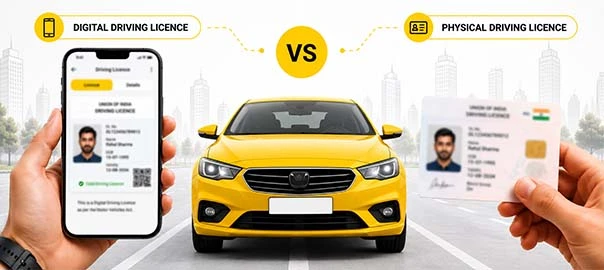
What are Digital and Physical Driving Licenses?
A physical driving license is the traditional card issued by the Regional Transport Office (RTO). It contains key information, such as the license number, photograph, and vehicle class authorisation. The physical license was always considered a valid legal document. It allowed individuals to operate vehicles on public roads. A digital DL in India is the electronic version of the same license. The only difference between the two is their format: one is physical, while the other is digital.
Key Differences Between Digital and Physical Driving Licenses
Both physical and digital driving licenses in India contain the same information. They also serve the same purpose, yet they differ in several respects. The following table covers the key differences between a physical and online driving license in India.
| Basis of Differentiation | Digital Driving License | Physical Driving License |
|---|---|---|
| Format & Storage | It’s stored electronically in platforms like DigiLocker and can be easily accessed through a smartphone. | It’s issued as a plastic card that should be carried physically whenever you drive. |
| Legal Recognition | The digital driving license will only be considered legally valid if it’s stored on authorised platforms, like DigiLocker. | Accepted as it is |
| Risk of Loss/Damage | Since the license is in digital format, it cannot be lost or damaged. Even if you lose it for some reason, there’s always an option to reinstate it. | A physical car carries a higher risk of getting lost, damaged, or stolen. |
| Reliability | It remains reliable only if you have access to an uninterrupted internet and a well-functioning smartphone. | Highly reliable in all situations. |
| Updates & Record Accuracy | The digital license is linked to government records, so any changes made to key information will reflect instantly. | Information will remain unchanged until the RTO issues a new plastic card. |
Digital and Physical Driving License Issuance Process
Some people mistakenly believe that physical and digital driving licenses are separate documents and are therefore issued separately. In reality, you only receive a physical driving license. The moment the RTO issues your driving license, it is automatically registered in government records. Once you connect your DigiLocker account to government records uploaded in the mParivahan app, you’ll automatically see the digital driving license in your account dashboard. Hence, there’s only an issuance process for the physical driving license, not the digital copy. To get the physical license, you must apply for a driving license at the RTO. Fill the form, upload the documents, and complete the driving test on the assigned date. Once everything is verified and your test is successful, you’ll receive the physical driving license.
What Are The Documents Required?
If you want a driving license, you’ll need to submit the following documents alongside the driving license form.
- Identity proof (Aadhaar card or passport)
- Address proof (Aadhaar card, passport, or utility bills)
- Duly filed driving license form (Form 2 for a learner’s license and Form 4 for a permanent license)
- Recent passport-size photographs
- A copy of the learner’s license (if you’re applying for a permanent license)
In addition to these documents, a medical certificate may be required for people aged 40 and above or for anyone applying for a commercial transport license.
What is The Verification Process?
Before any driving license is issued, the relevant authorities will first verify the individual’s identity, address, age, and supporting documents. If the submitted details and documents match what the government authorities find during verification, you’ll receive approval for the license. A verification process is necessary for every driving license application to prevent fraud and the issuance of a card to an ineligible individual.
Why Are Drivers Switching to a Digital Driving License?
More drivers are switching to a mobile driving license for the convenience it provides. Since the digital license can be accessed from anywhere, at any time, people no longer have to worry about the hassle of carrying a physical card or losing it while travelling.
Features of Digital Driving License
A digital driving license has the following key features –
Government-Verified Digital Record
A digital driving license (DL) in India is directly linked to official transport department databases. It allows the authorities to verify the document through government systems, reducing the risk of fake/altered/outdated license records.
Anytime, Anywhere Accessibility
You can access the electronic driving license copy through your smartphone at any time and from anywhere. It provides ultimate convenience and flexibility.
Reduced Risk of Damage or Loss
Since a digital driving license is stored in an electronic format, it cannot be damaged or lost. Even if it disappears temporarily, you can try reconnecting your DigiLocker to the relevant government database to retrieve it instantly.
Government Guidelines on Digital Driver’s License (DL) in India
According to the e-driving license rules, you can use your digital copy of the driving license. However, it should be produced through the DigiLocker app. You cannot take a picture of your driver’s license and upload it to any random cloud storage for later use. If you want legal validity and acceptance, you must use government-authorised platforms such as DigiLocker to store and issue the electronic version of the license.
What is The Eligibility
Indians aged 18 and above are eligible to apply for a permanent driving license in India. The age limit for applying for a learner’s license is 16, and applicants must have parental consent. If you’re applying for a permanent license, ensure you have already earned your learner’s license.
Are Digital Licenses Accepted Across India?
Despite the growing popularity of online driving licenses in India, some people are confused about their acceptance across the country. The Indian government has clarified that the digital driving license (DL) has the same legal status and acceptance as its physical version. However, there’s just one condition – the license should be generated, stored, and produced through a government-approved platform, such as DigiLocker. Manual uploads are invalid and can attract fines during travel.
Conclusion
Indian car owners should always carry their driving license while driving, as they may need it at any point during a random inspection by a traffic authority. If you often forget to carry your physical driving license, start carrying its digital copy on DigiLocker. It carries the same acceptance and legal validity as a physical card. For extra caution, ensure you’re always driving a car with a valid insurance policy. You can secure your four-wheeler under our Car Insurance policy, particularly the Comprehensive Car Insurance policy at Shriram General Insurance. If you own a bike, you can consider securing it under our two-wheeler insurance for enhanced protection.
FAQs
1. Can I take a picture of my driver’s license and use it during inspections?
No, you cannot. You must show the digital driving license stored in your DigiLocker account.
2. Are physical cards no longer accepted due to the digital license?
A physical driving license card is still valid, and so is its digital version stored in government-authorised platforms like DigiLocker.
3. Is it necessary to carry my driving license everywhere I travel?
Yes, it’s compulsory. You never know when a traffic police officer may stop you at a signal and ask for a license. Carrying it at all times is both recommended and beneficial.
4. What other documents do I need to carry besides a driving license?
Whenever you’re driving on public roads, it’s safe to carry all key documents, including the driving license, PUC certificate, and a copy of insurance papers.
5. Which is better: a digital or a physical driving license?
It depends on what you’re looking for. A physical card is good if you don’t want to become overly reliant on technology, and a digital card is better if you don’t want the hassle of carrying a physical driving license everywhere.