

Battery Swapping vs Fast Charging: Which is Better in India?
10 July,2026
Updated:30 September,2026
0 min read

share


Copied
 552
552Blog Blurb – This is a comprehensive guide on two popular EV charging methods: battery swapping and fast charging.
EVs have paved the way for clean energy mobility in India, but are people ready for their distinct charging requirements? Unlike a petrol or diesel car, you cannot simply refuel the vehicle within minutes and resume your journey.
In many cases, charging an EV battery to full requires an hour or more, depending on the charger, battery, etc. Thankfully, EV owners can now benefit from faster charging using two different methods – battery swapping and fast charging. We’ve covered both in this blog.
What is Battery Swapping?
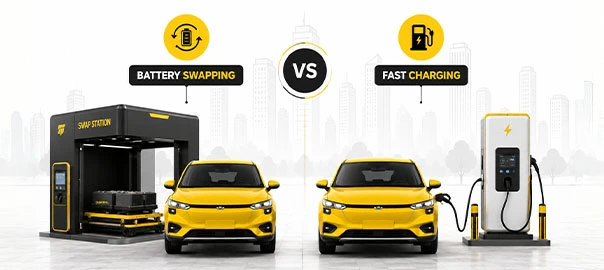
Battery swapping is an alternative to regular EV charging, in which the vehicle’s discharged battery is removed and then instantly replaced with a fully charged one. It instantly replenishes the EV’s charge, so you can resume your journey within minutes.
You cannot get battery swapping at any random EV charging station. It’s only available at dedicated battery-swapping stations and works only for compatible EVs with standardised batteries.
How Battery Swapping Technology Works
Battery swapping works on the simple principle of separating battery charging from vehicle usage. Compatible EVs are designed with removable battery packs that can be safely detached without complex tools. When the battery charge starts to run low, you can take your car to the nearest battery-swapping station and exchange the depleted battery for a fully charged one.
Once the new battery is installed, you can continue your journey. The depleted battery you exchanged at the station is later inspected and recharged under controlled conditions, and then returned to the station’s inventory for future use.
Types of Vehicles Using Battery Swapping
In India, two and three-wheeler EVs mostly use battery swapping. Heavy-duty commercial e-trucks and select commercial delivery fleets are also using battery swapping because it significantly improves their operational efficiency.
However, battery swapping for cars isn’t yet available in India. You’ll mostly find personal electric car owners using the traditional EV charging infrastructure to recharge their electric vehicles.
Current Status of Battery Swapping in India
Although the government has begun building battery-swapping infrastructure across India, it is still in the early stages. In December 2024, there were approximately 25,000 public EV charging stations in India, whereas the number of battery-swapping stations was only 2,500. However, people can expect to see a broader network of battery-swapping stations in India in the coming years.
What is Fast Charging?
Fast charging is a popular method of charging an electric vehicle using high-power direct current (DC) chargers. They deliver electricity directly to the car’s battery, which is why charging time is significantly shorter than with standard AC chargers.
It’s very similar to how regular EV charging works; the only difference is that it’s faster because the high-powered direct current bypasses the car’s internal converter to deliver more power. It’s fast becoming the primary public charging solution for most electric cars in India.
How Fast Charging Works for Electric Vehicles
EV batteries store electricity as Direct Current (DC), but the electricity supplied by the power grid is Alternating Current (AC). When you use DC fast chargers at EV stations, the electricity conversion occurs inside the charging station rather than in the vehicle.
Hence, the electricity flows into the battery at a much higher power. The vehicle’s Battery Management System (BMS) continuously monitors the battery temperature, voltage, and state of charge to regulate charging speed safely.
As the EV battery nears full charge, the charging rate gradually slows down to protect battery health and improve long-term performance.
Types of EV Fast Chargers Available in India
Although there are different types of EV fast chargers available in India, we’re sharing the key ones.
Combined Charging System 2 (CCS2)
It’s the most widely used DC fast-charging standard for modern electric cars in India. Most new passenger EVs support CCS2, making it the dominant connector at public fast-charging stations.
Bharat DC-001
Developed specifically for the Indian market, Bharat DC-001 was introduced primarily for earlier-generation electric cars with low-voltage battery systems. Although it’s still available in some charging stations, newer passenger EVs are shifting to CCS2.
CHAdeMO
It’s a Japanese DC fast-charging standard used by a limited number of older EV models. You can still find these chargers in some stations, but their adoption has gradually decreased over time.
GB/T Chargers
Built on Chinese charging standards, GB/T connectors are used by certain electric buses, commercial vehicles, and a few specialised EV models. They’re far less common in India’s passenger car charging network; CCS2 remains the most popular charger.
Charging Speeds and Time Requirements
The time required to charge an EV depends on the charger’s power output, battery size, the vehicle’s maximum charging acceptance level, and numerous other factors. However, you can use the following time for reference.
| Charging Level | Power Output | Estimated Charging Time | Best Suited For |
|---|---|---|---|
| Level 1 (Standard Home Charging) | 2-3.5 kW | 8-12 hours | Overnight home charging and users with low daily driving requirements. |
| Level 2 (AC Charger) | 7-22 kW | 3-6 hours | Regular charging at homes, offices, apartment complexes, etc., for daily drivers. |
| Level 3 (DC Fast Charging) | 50-350 kW | Up to 80% charge within 20 to 60 minutes | Highway travel, long-distance journeys, commercial fleets, etc. |
Battery Swapping vs Fast Charging: Key Differences
EV owners can choose the right battery powering solution when they have a clear understanding of all the available options. Hence, we’ve created this battery swapping vs fast charging comparison to help you make an informed choice.
| Basis of Differentiation | Battery Swapping | Fast Charging |
|---|---|---|
| How Does It Work? | The discharged EV battery is first removed and then replaced with a fully-charged one at a swapping station for instant power. | The vehicle’s existing battery is charged using a high-power DC charger. |
| Time Required for Charging | Since the battery is replaced rather than charged, the process is quick and takes only a few minutes. | If you’re using a Level 3 DC fast charger, the EV can charge to 80% in 20 to 60 minutes. |
| Battery Ownership | The battery is usually owned and maintained by the service provider. | Since the battery isn’t detached from the vehicle for charging, the battery ownership remains with the vehicle owner. |
| Compatibility | Only vehicles designed with detachable battery packs. Compatibility also depends on the battery size, design, and standardisation. | Most EVs support DC fast charging, so you can use any compatible public fast chargers. |
| Best Suited For | Commercial fleets, scooters, auto-rickshaws, etc. | Private passenger cars |
Factors Affecting EV Charging Cost in India
The EV charging cost varies significantly in India, depending on the following factors –
Type of Charging Station
EV charging costs vary across home charging setups, AC public chargers, and DC fast chargers. Fast chargers usually cost more than other charging options because they require expensive, specialised equipment and higher power capacity. They’re also difficult to maintain, attracting a premium convenience fee.
Electricity Tariffs and Charging Network Pricing
Electricity tariffs differ across states, while public charging operators set their own pricing models. Operators generally finalise pricing based on infrastructure, operating costs, and location. As a result, charging the same EV can cost differently across cities or charging networks.
Battery Size & Energy Consumption
Larger battery packs require more electricity to recharge, resulting in higher charging costs. Similarly, EV’s with lower energy efficiency consume more electricity/km, which increases the overall cost of ownership.
Charging Habits & Battery Level
Charging from a very low battery level naturally requires more electricity than topping up a partially charged battery, thereby increasing charging costs. Also, if you frequently use public fast charging infrastructure over home charging, then the EV charging cost will also be higher.
Advantages of Fast Charging
Fast charging usually stands out as a better option than the regular AC charging option because of its speed. You can also choose it for the following advantages.
Minimises Charging Time
If you suddenly have to travel a long distance and your EV doesn’t have enough charge, fast charging can help. At public fast chargers, you can fully replenish your car’s battery in about an hour. Other methods would take around 6 hours, which isn’t practical during an emergency or long-distance travel.
Works with Most Modern Cars
The best part about fast charging is that most private electric cars are compatible with fast chargers. Hence, you don’t have to make any battery modifications or look for specific battery-swapping stations, which are comparatively fewer in number than regular EV charging stations.
No Need to Exchange Batteries
Not every EV owner is comfortable with exchanging their car battery with a new one at a swapping station. If you want to keep your EV’s original battery and still enjoy faster charging times, fast charging is the best option.
Conclusion
Both fast charging and battery swapping are great options for recharging EV batteries, whether fully or partially drained, but which is better? It’s a question many EV owners ask. To help EV owners make the right choice, we’ve shared a detailed battery-swapping vs fast-charging analysis that answers their common questions. If you’re looking to secure your car under better coverage, consider exploring the different Car Insurance plans at Shriram General Insurance.
FAQs
1. Fast charging or battery swapping: which is better?
None is universally better. You can choose battery swapping if your EV supports it, or opt for fast charging.
2. How long will it take to recharge an EV using a Level 3 DC charger?
If you’re using a level 3 DC charger, you can expect the EV to charge up to 80% within 20-60 minutes. The precise time will depend on the battery’s size, capacity, and other factors.
3. Is battery swapping available for all electric vehicles?
No, not every EV is designed to support battery swapping. If you already own an EV, check its manual to see whether it supports battery swapping.
4. Can I get battery swapping at any EV charging station?
Not necessarily. Although some EV charging stations have a battery swapping facility, most provide only standard EV charging via AC or DC chargers.
5. Is EV charging cost higher across India?
It isn’t necessarily expensive in every Indian city. The cost will depend on your location, charging mode, and charging network.