


Upcoming Car Safety Rules Every Driver Should Know
10 October,2026
Updated:10 October,2026
0 min read

share


Copied
 35
35This blog covers upcoming and new car safety rules in India that every driver should know.
Car safety rules have existed in India for decades, but they’ve been routinely updated to keep up with the evolving driving environments, changing driving behaviours, and vehicle designs. Over the past few years, the Indian government has rolled out several new car rules to improve road safety.
These rules aren’t limited to airbags, seat belts, or crash-testing rules. They’ve gradually expanded to cover crash prevention, connected car technology, electric vehicles, and other areas we’ve covered in this blog. If you’re curious to explore the latest and upcoming car safety rules in India, read the full blog.
Why Are Car Safety Rules Becoming More Important?
Car safety rules are becoming more prominent in India to address the rising cases of road accidents and deaths. At a recent road safety event in New Delhi, India’s Road & Transport Minister, highlighted the country’s concerning road safety crisis.
The Ministry highlighted nearly 5 lakh road accidents are reported in India each year, of which 1.8 Lakh cases lead to death. Roughly 20 people die every hour on Indian roads; a fatality intensity that you wouldn’t even see due to a war or disease.
Authorities have already reported 2,85,770 road accident cases in the first six months of 2026, raising serious concerns about how unsafe driving has become. The government expects new car rules in India to improve this situation by boosting road safety and vehicle protection.
Upcoming Car Safety Rules in India
The government is working to introduce new car safety rules in 2027 and the following years to improve road safety, potentially lowering the instances of road accidents. Here are a few upcoming car safety rules every driver should know.
● Bharat NCAP 2.0
The existing Bharat NCAP program is being upgraded and will become more comprehensive starting October 2027. It will expand the scope of car safety assessment by covering not just occupant protection but also post-crash evacuation & care, crash avoidance, and pedestrian safety.
It will raise the bar for how new cars are assessed, ensuring only the most secure cars receive a higher rating. This will encourage people to buy cars with safety features, accident-avoidance technology, etc., reducing the likelihood of road accidents.
● Graded Point System for Driving Licences (DL)
Although it’s still under consideration, the government is evaluating a proposal to improve driving behaviour by introducing a graded point system for driving licences and vehicle registration certificates. If approved, it will improve road safety by rewarding responsible driving behaviour.
Repeated traffic offences, such as overspeeding, driving without wearing a seat belt, or not carrying valid documents, can lead to point deductions. The driver’s license can be suspended if a specific threshold is crossed, while responsible drivers will earn points.
Those with higher points may receive incentives from insurance companies. It will encourage everyone to drive carefully, making driving environments safer.
● V2V Safety Tech
Authorities have proposed making Vehicle-to-Vehicle (V2V) safety tech compulsory for all new vehicles, including cars and bikes, starting in 2028. It lets vehicles communicate with each other, alerting them about road hazards beyond the driver’s direct line of sight.
For instance, a vehicle approaching from a blind intersection can alert your vehicle in advance, helping you avoid a collision.
● Acoustic Warning Systems for EVs
This point is for EV owners. Since electric vehicles have a silent powertrain, pedestrians may not hear any sound if an EV approaches them or drives near them. This may lead to avoidable pedestrian accidents that could have been averted if people had heard the car approaching and acted accordingly.
Hence, the government is considering making acoustic warning systems mandatory for electric vehicles from 2027. This car safety rule, starting in 2027, may require EVs to use external speakers to warn pedestrians of the car’s movement with an artificial sound.
New Car Rules in India: What Drivers Should Know
Over the past few years, authorities have rolled out several new car safety rules in India. Here are the key rules every driver should know.
● 5-Strike System
Starting 1st January 2026, a 5-strike rule was introduced under which the RTO or district transport office can briefly suspend your driving licence if you receive five challans for traffic violations within 12 months.
Crossing this threshold can lead to a three-month driving ban. Such a harsh rule was introduced to discourage unsafe driving behaviours, such as overspeeding on busy roads, using a mobile phone while driving, etc.
● Wearing Rear Seat Belts is Mandatory
This new car safety rule in India became mandatory in 2022. Under this rule, passengers in the rear seat of a car must wear rear seat belts. Non-compliance will attract around ₹1,000 penalty along with a warning.
If the car doesn’t have a three-point seat belt for the middle passenger on the rear seat, they can use a lap belt to comply with the law. Wearing rear seat belts can help passengers stay seated during collisions, minimising injury severity.
● Compulsory HSRP Number Plates on All Vehicles
Another car rule every Indian driver must know is the mandatory use of HSRP number plates. Now, every vehicle owner must replace their old vehicle number plate with an HSRP number plate.
This rule was introduced to improve vehicle identification, eliminate tampering-related crimes, and strengthen overall road safety. Non-compliance can attract penalties of up to ₹10,000.
● Legal Acceptance of Digital Car Documents
Although this isn’t a new rule for cars in India, every driver must know it to ensure smooth trips. Under this rule, drivers can now carry key vehicle documents, such as a driving licence, vehicle registration, insurance papers, etc., in digital format. They will have the same legal validity as physical documents.
However, remember to store these documents on authorised platforms like DigiLocker and the mParivahan app. Digital documents stored in any other medium won’t be considered valid.
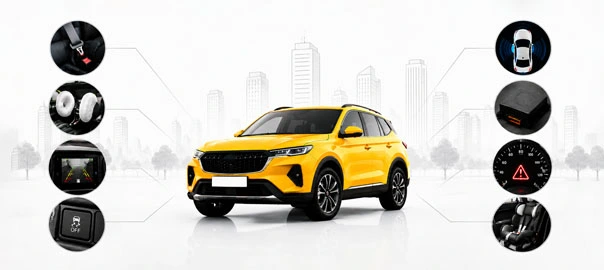
Mandatory Car Safety Features to Look For
If you’re buying a new car, you should look for the following mandatory car safety features –
● Airbags
Every car must have airbags as part of its safety suite because they can protect occupants during a road crash or collision. They inflate during road accidents so occupants don’t get injured by the steering wheel, dashboard, doors, or other hard surfaces. Depending on their type and position, they can protect your head, chest, and other vulnerable body areas during a crash.
● Anti-lock Braking System (ABS)
Another mandatory car safety feature, ABS prevents the wheels from locking when the driver brakes hard. It lets you maintain steering control while slowing down. You can use it to steer around an obstacle or maintain directional control during emergency braking, reducing the risk of a collision.
● Seat Belt Reminder
As the name suggests, a seat belt reminder alerts occupants when a seat belt is not fastened. The alert can be visual or audible. It reminds occupants to wear their seat belts before the journey begins.
● Electronic Stability Control
With Electronic Stability Control (ESC), your car can detect when it’s losing its intended path, which usually happens during a sudden evasive manoeuvre or on slippery roads. This system can selectively apply brakes on individual wheels to prevent the car from losing control.
● Rear Parking Sensors
Every car needs rear parking sensors to alert drivers about potential obstacles behind their vehicle while reversing. They’re particularly useful in crowded parking areas and tight spaces where pedestrians or other objects can be difficult to see through the rear windscreen/mirrors.
They help you compensate for rear blind spots, making it easier to avoid collisions with people or objects around you.
Can the New Rules for Cars in India Affect Drivers?
Yes, the new rules for cars in India will affect drivers. Many of the new rules, such as the 5-strike system, are designed to improve drivers’ driving behaviour. The rules will penalise irresponsible drivers while incentivising responsible ones, encouraging safer driving.
Rules around wearing rear seat belts will promote safe driving habits. Since the rules are diverse, their impact will depend on the type of rule applicable to the driver.
What Should New Car Buyers Check Before Purchasing?
People planning to purchase a new car should check the following before finalising a car –
● Check the Car’s Bharat NCAP Rating
The Bharat NCAP rating gives you an independent assessment of how the car performs in controlled crash environments. If you’re primarily looking for secure cars with reliable safety features, then this rating can help you choose the right car.
Look for a car with a higher Bharat NCAP rating, as it usually indicates better occupant protection in a crash.
● Compare Safety Features Across Variants
Not every car variant has the same set of safety features. In some cases, advanced safety features are reserved for higher-priced variants, not base models.
Hence, compare the available safety features across variants to choose the most relevant, feature-rich option. Ideally, look for safety features such as rear parking sensors, a 360-degree camera, automatic emergency braking, lane-keeping assist, and electronic stability control.
● Look Beyond the Number of Airbags
While airbags are crucial safety features, they shouldn’t be the only thing you consider. Beyond the number of airbags, you should also look at the car’s structural performance, seat belt systems, electronic safety features, etc., to understand the vehicle’s broader approach to occupant protection.
● Explore Active Safety Features
Consider prioritising a car with active safety features, such as traction control, brake assist, blind spot monitoring, and adaptive cruise control, as they’re designed to help prevent crashes rather than only reduce injury severity after a road accident.
How Can Drivers Stay Compliant With New Safety Rules?
The easiest way is to follow all the rules we’ve discussed in the previous sections. Here’s a quick recap of the key rules so you can remain compliant without any hassle –
- Make every passenger wear a seat belt, including those in the rear seat, before starting the trip.
- Avoid breaking any traffic rule, such as overspeeding, driving without valid documents, or using a phone while driving, to prevent getting a challan.
- If you receive a challan, pay it within the prescribed time line to avoid further consequences.
- Ensure your car has the latest HSRP number plate, not the old one.
- If you cannot carry physical car documents at all times, store them in DigiLocker or show them to traffic authorities via the mParivahan app, as they have the same legal validity as physical documents.
- Drive responsibly so you don’t cross the five challans threshold within 12 months.
Conclusion
Every Indian car owner must follow the car safety rules launched by the relevant authorities. Compliance with these rules is non-negotiable and aims to make Indian roads safer for everyone. We’ve covered all the latest and upcoming car safety rules in this blog, so you know which rules to follow at all times.
Since the rules also require valid insurance for cars, make sure your vehicle is covered under a valid Car Insurance policy. You can explore our Comprehensive Car Insurance plan if you’re seeking enhanced financial protection for your car.
FAQs
Do only front passengers have to wear seatbelts?
No, the new car safety rules require everyone, including those sitting in the rear seat, to wear seatbelts before starting the journey.
What if my car doesn’t have a three-point seatbelt for the middle occupant in the rear seat?
In such cases, the middle passenger can wear a lap belt to comply with safety requirements.
Why have car safety rules become so important in recent years?
Car safety rules have become more important because of rising road accidents. These rules aim to make Indian roads safer for everyone and minimise road accidents.
What is the 5-strike rule in India?
It’s a car rule designed to improve people’s driving behaviours. Under the 5-strike rule, if you receive five or more challans within 12 months for traffic rule violations, you may face a three-month driving ban. In such cases, your driving license may be briefly suspended.
Are acoustic warning systems mandatory for EVs?
No, not yet. However, the government plans to mandate acoustic warning systems for EVs starting in 2027.