

Undercoating and Rustproofing: Essential Protection for Coastal and High-Humidity Regions
06 March,2026
Updated:30 September,2026
0 min read

share


Copied
 2786
2786This blog explains undercoating and rustproof coating for cars. It’s a must-read for every car owner living in coastal and high-humidity regions.
Vehicles in coastal and high-humidity regions in India are more prone to erosion than those in inland and dry regions. The faster erosion has nothing to do with the car’s built-in quality; it’s all about the region’s high moisture and salt content.
If you live in Mumbai, Goa, Kochi, or any coastal and high-humidity city, you’ll know the air and water in these places have a high salt concentration. Once a vehicle comes into contact with it, oxidation begins almost immediately. The only practical way to prevent it is to apply car undercoating and rustproof coating. We’ve covered each in this blog, so make sure you read it until the end.
What is Car Undercoating?
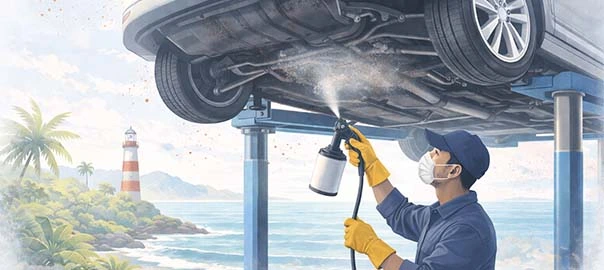
Car undercoating is an external protective layer applied to a vehicle’s underside. It protects the underside from moisture, road salt, mud, and stone impact. You cannot see the underside of your car unless it’s lifted.
It comprises the floor pan, chassis frame, suspension mounts, wheel wells, and other metal components that directly face the road. When this side of your car is constantly exposed to salt-laden moisture and water, some of it can attach to lightly protected metal.
This is what accelerates oxidation, gradually leading to rust formation. A car undercoating, usually made of rubberised or asphalt-based material, forms a dense barrier over the metal surface, protecting it from corrosion and rust-causing agents.
What is Rustproofing?
Rustproofing is a preventive treatment designed to stop corrosion from forming on a car’s metal surfaces. The key difference between car undercoating and rustproofing a car is that the latter protects hidden and hard-to-reach areas.
It forms a protective shield in your car’s internal cavities, including door panels and seams where moisture gets trapped. To apply rustproof coating, you must spray oil-based or wax-based anti-corrosion chemicals inside these cavities. Since these substances are thinner than undercoating materials, they effortlessly seep into seams and joints.
They displace moisture and create a protective film over the metal from the inside. Hence, rustproofing can be best described as an internal corrosion prevention method for hidden metal areas.
How to Choose Rustproof Coating
People new to rustproof coating can easily get overwhelmed by the wide variety of coating solutions available in the market. You can make your search easier with the following tips.
Know Your Environment and Climate
You should always choose rustproof coating products based on where you live. Those living in high-humidity and coastal regions should choose products that penetrate internal cavities to displace moisture. These are the most effective because they stop rust where it starts, i.e., inside the car’s seams and joints, not just on the surface.Understand the Type of Coating Materials
Rustproof coatings come in oil/wax-based, polymer/rubberised, and tar/asphalt categories. Wax/oil-based coatings are best for corrosion resistance inside cavities as they creep into tiny gaps and displace moisture. While rubberised/polymer coatings can absorb minor impact, they can crack under pressure.Evaluate Longevity and Warranty
Some coatings provide multi-year warranties. You should explore more such options, as a longer warranty indicates confidence in a product. It also signals longevity, which can save money in the long term.How Rustproofing a Car Helps
Rust proofing a car helps in the following ways.
Prevents Oxidation and Corrosion
Rust proofing creates a chemical barrier between metal surfaces and salt-laden moisture and other corrosive elements. It slows the oxidation process, keeping structural parts stronger for extended periods.Protects the Inside Hidden Cavities
Salty moisture often enters internal cavities, such as the car’s door frames and sills. While these areas are not visible, they’re highly prone to rust. Rustproofing can seal these areas, blocking corrosion at the source.Increases Vehicle Lifespan
Rust proofing extends your vehicle’s service life by preventing corrosion before it spreads. It leads to fewer structural repairs. It also helps the vehicle deliver more durable performance over the years.Enhances Resale Value
Visible rust or signs of underbody corrosion can erode buyer confidence and reduce a car’s resale value. You can use rustproofing to maintain your car’s condition, which can get you a higher resale value.Undercoating vs. Rustproofing
Car owners who are still confused about the difference between undercoating and rustproofing should explore the comparison table below on undercoating vs. rustproofing.
| Basis of Differentiation | Car Undercoating | Rust Proof Coating |
| Primary Objective | Protects exposed underbody metal from salt-laden water, high-moisture air, stone chips, and other corrosion agents | Prevents corrosion from starting inside the car’s hidden cavities where moisture gets trapped |
| Area of Application | Floor pan, chassis frame, wheel wells, and other underbody components | Inside doors, pillars, frame rails, seams, and other harder-to-reach cavities |
| Threat Handling | External | Internal |
| Protection Mechanism | Creates a physical shield between metal and external environment | Creates a chemical barrier that displaces moisture and inhibits oxidation |
| Best Time to Apply | Ideally, when the car is new and rust-free | Best applied when the car is new, but it works equally well on older vehicles if rust hasn’t advanced deeply |
| Visibility | Clearly visible as a black textured layer under the car | Mostly invisible as it’s applied inside enclosed cavities |
Best Underbody Coating for Cars
People looking for the best underbody coating products for cars can explore the following options.
| Best Underbody Coating Products | Key Highlights | Price |
| MAFRA Lubrigraph Underbody Protection Spray |
|
₹916 |
| Uniwax Underbody Coating |
|
₹1,900 |
| Liqui Moly Bitumen Underbody Protection |
|
₹1,999 |
| Rust-Oleum Automotive Undercoating Spray |
|
₹2,594 |
Long-Term Rust Protection for Vehicles
You need long-term rust protection for your vehicle to preserve its structural strength and safety throughout its life. Simply put, rustproofing your car can reduce the need for costly repairs by preventing corrosion at its source. If you seek long-term rust protection for your vehicles, you must follow the tips below.
Regular Inspections and Maintenance
Make it a habit to periodically check vulnerable areas, such as the chassis frame and wheel wells. It will help you catch early signs of rust, so you can address problems before they spread.Scheduled Reapplication of Coatings
Even the best rustproof coatings wear over the years. Hence, reapplying them every few years can ensure continuous protection. You can check the manufacturer-recommended reapplication frequency.Underbody Wash After Salt or Water Exposure
If you’ve driven your car frequently during monsoon season, you should have the underbody professionally washed. A simple wash can remove salt, mud, and grime, reducing the risk of corrosion.Park in Shaded or Dry Areas
Aim to minimise exposure to moisture to slow the rusting process. These simple habits can deliver the maximum benefits.Car Rust Proofing Cost in India
Car rustproofing costs in India can vary by location, the type of rustproofing solution you’re availing, your car’s size, and numerous other factors. However, you can use the following as an estimate of the average cost.
| Service Details | Estimated Cost |
| Silencer/exhaust Coating | ₹800 – ₹1,500 |
| Cavity Wax | ₹2,000 – ₹5,000 |
| Underbody Coating | ₹3,000 – ₹7,000 |
| Full Rust Protection Package | ₹8,000 – ₹15,000 |
Conclusion
Undercoating and rustproofing are the best investments you can make for your four-wheeler, especially if you live in high-humidity or coastal regions. These treatments ensure your vehicle isn’t prone to corrosion from the region’s high levels of salt in the air and water.
While these coatings will protect your vehicle against fast corrosion and rust formation, they won’t secure your car financially. For financial protection, you must cover it under a dependable Car Insurance plan. You may explore Shriram Car Insurance plans if you’re primarily seeking great coverage at affordable premiums.
FAQs
1. Is rust proofing necessary for all cars?
It’s necessary for cars in highly humid, coastal regions, where factory anti-rust treatments can become ineffective.
2. How long does rust proofing last?
It depends entirely on the quality of your rustproofing solution and the environment your vehicle is regularly exposed to. However, you can expect high-quality rustproof coatings to last 2 to 5 years.
3. Can I rustproof my car?
You can choose to rustproof your car as a DIY project, but it may not deliver the results you expect. A professional application is a better choice for its effectiveness and durability. A professional application can deliver far better results.
4. When should I apply rustproofing coating on my car?
It’s best to apply rust proofing soon after vehicle purchase, but you can also apply it to older vehicles if rust hasn’t become stubborn.
5. Does rust proofing help reduce noise?
Some coatings with rubberised components can slightly dampen road noise, but you should treat it as a secondary benefit.