

Converting Your Car to Flex-Fuel: CNG-Petrol Dual Systems and Government Incentives
Posted:
17 March,2026
Updated:30 September,2026
0 min read

share


Copied
 8013
8013This is your introductory guide to petrol CNG cars and CNG retrofit solutions used for CNG car conversion.
Petrol prices are volatile in India, but they’re rarely inexpensive for long-distance commuters. If you use your car for regular long-distance commutes between home and office and weekly leisure travel, high fuel expenses can become one of your biggest challenges to travel convenience.
You can save on it by converting your regular petrol car into a petrol CNG car. Since CNG is comparatively cheaper than petrol, you can enjoy the same amount of travel at a much lower operational cost. This blog covers how you can transform your four-wheeler into a dual-fuel car for cost savings and other benefits.
Petrol prices are volatile in India, but they’re rarely inexpensive for long-distance commuters. If you use your car for regular long-distance commutes between home and office and weekly leisure travel, high fuel expenses can become one of your biggest challenges to travel convenience.
You can save on it by converting your regular petrol car into a petrol CNG car. Since CNG is comparatively cheaper than petrol, you can enjoy the same amount of travel at a much lower operational cost. This blog covers how you can transform your four-wheeler into a dual-fuel car for cost savings and other benefits.
Describe the Petrol CNG Car
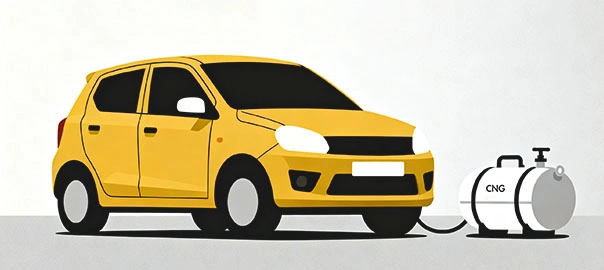
A petrol CNG car is a conventional petrol vehicle that has been modified to run on two different fuel options – petrol and CNG. In these vehicles, the original petrol engine remains unchanged.
What changes is the addition of a CNG fuel system that lets the same engine run on compressed natural gas. As a driver, you have the option to switch between petrol and CNG using a switch installed inside the cabin. This flexibility is what makes these dual-fuel cars a practical choice.
If you want the dual benefits of CNG’s low running costs and the convenience and reliability of petrol, then converting your car to a petrol-CNG option is a wise choice.
CNG Retrofit Solutions for Flex-Fuel Cars
CNG retrofit solutions are designed to convert petrol-only cars into petrol CNG cars. For a successful CNG car conversion, you must choose a kit that matches your car’s engine type and emission standards.
The CNG retrofit solutions typically fall into two categories -
Venturi CNG Kit
Venturi kits are simpler, first-generation CNG conversion technology. It features a simple working mechanism and is ideally recommended for carburettor-based or older fuel-injected engines. Although inexpensive, venture CNG kits are known to be less efficient and may affect engine performance.Sequential CNG Kit
It’s the most common and advanced technology used in CNG petrol car conversions. You can use this kit for cars featuring modern fuel-injected petrol engines. These systems use electronic controls to deliver gas to each engine cylinder precisely, making them more efficient and smoother to operate.Sequential CNG retrofit solutions are widely recommended for modern cars because they maintain better fuel efficiency. They also reduce engine knocking and provide improved driving performance compared to venturi systems.
What is CNG Car Conversion?
As the name highlights, it’s the process of converting a regular petrol car into a petrol CNG car. The CNG car conversion process involves installing a certified CNG retrofit kit into eligible vehicles, creating a separate fuel system for the vehicle.
Some car owners mistakenly believe the process involves a full engine replacement. In reality, the car’s engine is not replaced. Instead, a new system is added that injects CNG into the combustion chamber when the driver selects the CNG mode. Once the kit is installed, the vehicle becomes a dual-fuel car.
CNG Car Conversion Cost in India
The CNG car conversion cost in India depends on the type of CNG retrofit kit used, its brand, and other key factors. If you own a modern car and are exploring dependable sequential CNG kits, you can expect to pay approximately ₹30,000 to ₹45,000.
Venturi CNG kits are priced between ₹20,000 and ₹30,000. In addition to the initial CNG kit cost, you’ll need to pay ₹4,000-₹8,000 for standard installation charges.
These charges may be higher for express installation services. You might also have to pay a higher installation fee if you’re converting a luxury vehicle. You should contact a government-certified CNG conversion centre to get precise conversion quotes.
What is the Benefit of a Dual-Fuel Car?
Upon successful conversion, you can enjoy the following petrol CNG dual-fuel benefits.
Lower Fuel Cost
Since CNG is comparatively cheaper than petrol, drivers can notice an immediate reduction in fuel costs. This reduction can be significant for people who regularly travel long distances for work, leisure, or other purposes.Flexibility of Two Fuel Options
A dual-fuel car lets you switch between petrol and CNG depending on availability and convenience. If CNG stations are not nearby, the vehicle can switch to petrol immediately. This flexibility makes the car ideal for both city driving and long off-road journeys.Lower Emission
CNG is a cleaner fuel option than petrol. Hence, it generates significantly lower emissions, which helps minimise urban air pollution.How Flex Fuel Policy Works in India
The push for a flex-fuel policy in India is not random. It’s closely linked to the country’s broader energy goals, particularly the goal to reduce dependence on imported petroleum. The government is enforcing the flex-fuel policy by letting cars run on alternative fuels, such as CNG.
To push this initiative, the government plans to incentivise this shift by including automobiles and auto components for flex-fuel engines under the Production Linked Incentive (PLI). Plans to expand the CNG distribution network across Indian cities are also on the cards.
Since the government allowed retrofitting CNG and LPG kits for BS6 vehicles in 2022, more cars now operate under the flex-fuel policy. As a result, dual-fuel cars use less petrol and emit less carbon, thereby having lesser negative impact on air quality.
The Process of CNG Petrol Car Conversion
CNG petrol car conversion can only be done at an authorised retrofit centre. Here’s how the process looks in real life.
Vehicle Inspection
The process starts with a thorough vehicle inspection. This inspection determines whether your car is eligible for conversion. If eligible, the technicians will proceed with the conversion process. They will begin by choosing the right CNG kit based on your car’s model and engine type.CNG Cylinder Installation
The CNG cylinder is securely mounted in the car’s boot area. In this step, technicians use strong brackets and safety clamps to ensure secure placement -a placement that isn’t disturbed during vehicle movement.Fitting the Regulator and Fuel Lines
A pressure regulator is installed near the engine. The primary purpose of this regulator is to reduce the CNG pressure to a level that’s safe for engine combustion.Integration with Engine and ECU
The CNG kit’s electronic control unit (ECU) is then connected to the vehicle’s engine system. This is followed by installing injectors to help the car’s engine receive CNG. The ECU is used to manage the fuel supply, ensuring smooth switching between petrol and CNG modes.Installation of the Fuel Switch and Gauge
Technicians then install a switch inside the cabin that facilitates effortless switching between petrol and CNG. The same panel also includes a fuel indicator that shows how much CNG is left in the cylinder.Testing and Certification
Lastly, technicians conduct a final test to check for gas leaks, engine performance, and fuel switching. If everything is fine, the conversion is certified. Once done, the vehicle must be updated in the RC to be listed as a CNG-fueled car.Core Components of a Car CNG Kit
A CNG car kit contains several components. We’ve listed the most important ones below.
CNG Cylinder
It’s a high-pressure cylinder that stores the CNG. You will mostly find it fitted in the car’s boot space.Pressure Regulator
This regulator reduces the extremely high pressure of stored gas to a level suitable for engine combustion.Fuel Injectors
These components are used to push gas into the engine in controlled amounts.Electronic Control Unit (ECU)
The ECU helps manage fuel delivery in your car. It lets the car’s engine switch between petrol and CNG operation.Fuel Switch and Indicator
Installed inside the cabin, this component enables the driver to switch between petrol and CNG modes.Final Thoughts
Driving a dual-fuel car is one of the smartest things you can do as an Indian vehicle owner. This simple switch from petrol-only to petrol CNG car gives you plenty of flexibility and cost-saving opportunities. If you’re ready to cut down hefty petrol bills, say yes to CNG car conversion.
Once you’ve finished the conversion, don’t forget to update the Car Insurance policy to enjoy uninterrupted financial protection. If you’re planning to secure your four-wheeler under a more reliable Comprehensive Car Insurance policy, then explore the plans available at Shriram General Insurance.
FAQ
1. Is it necessary to convert my car to a flex-fuel option?
No, it’s not necessary. However, you can choose to upgrade it if you want to enjoy its fuel cost and flexibility benefits.
2. How much does it cost to convert a car into a dual-fuel car?
The cost depends on the type of CNG (compressed natural gas) retrofit solution you choose. For example, the venturi CNG kit will cost you approximately ₹20,000 to ₹30,000. However, the sequential CNG kit will cost you approximately ₹30,000 to ₹45,000. These figures don’t include the installation charges.
3. How many types of CNG retrofit solutions are available?
You’ll find two types of CNG retrofit solutions – venturi and sequential.
4. Can BS6 cars be converted into dual-fuel vehicles?
Yes, the government legally allows BS6 vehicles to be converted into petrol-CNG cars.
5. How long is the CNG car conversion process?
In most cases, the conversion can be finished within a few hours. However, some cases may take slightly longer.