AI Features in Cars What Every Driver Should Know
06 November,2026
Updated:06 November,2026
0 min read

share


Copied
 39
This is a detailed guide on AI in cars so you understand how it’s being integrated into modern cars, its benefits, key AI features in cars worth knowing, and more.
A few years ago, AI integration was limited to certain high-end car models. However, it is now becoming standard across cars of varying price range. Whether you’re buying a car under ₹10 Lakh, ₹15 Lakh, or ₹20 Lakh, you’ll find some form of AI in cars, depending on the vehicle segment and price bracket.
Hence, it’s crucial that you acquaint yourself with the fundamentals of artificial intelligence in cars. It will help you optimise driving experiences for maximum comfort and safety. This guide on AI automotive technology shares all the relevant information you must know about AI in cars.
What is Artificial Intelligence (AI) in Cars?
AI is an advanced form of technology that lets machines perform all tasks that usually require human intelligence. Integrating this technology into cars creates smart vehicle systems capable of -
- Interpreting information
- Recognising patterns
- Understanding requests
- Performing specific tasks
The voice assistants you use for navigation or autonomous parking you use for safe parking are all examples of AI features in cars.
How is AI Used in Cars?
The usage of AI in cars is incredibly versatile; there isn’t a single, fixed way manufacturers use it. We’re sharing a few common ways in which AI is being used to improve the driving experience.
- Analysing the Road Environment
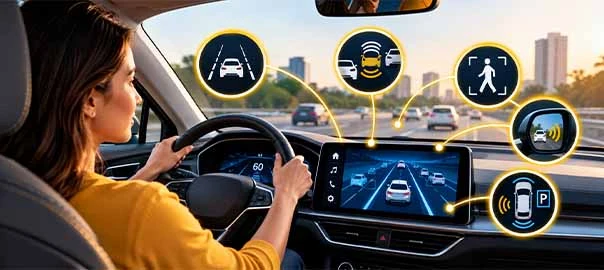
AI systems use camera vision, radar data, and other smart car technologies to identify potential road hazards in the car’s immediate environment. This information helps drivers receive timely collision warnings, apply automatic emergency braking, and support other driver assistance features.
- Understanding Voice Commands
AI-powered speech recognition systems paired with advanced language processing models are being used to help vehicles interpret complex spoken requests. Depending on your car’s system, you can ask AI to give directions to a specific place or adjust supported cabin settings.
- Monitoring Driver Behaviour
AI-powered advanced driver monitoring systems analyse drivers’ eye movements, head position, and other observable signs to identify potential distraction or fatigue. Depending on the system, it can issue timely warnings so the driver can take a break or correct their driving behaviour.
Key AI Features in Cars Every Driver Should Know
Not every car has the same set of AI features. They vary significantly by vehicle segment, price, and brand. If you’re keen to explore the best AI features in cars, check out the list below.
- Generative AI Voice Assistants
These assistants aren’t limited to predefined voice commands. They’re designed to understand complex verbal requests and respond accordingly. You can have natural conversations with these assistants and even ask them to -
- Plan a road trip
- Discover nearby hotels, restaurants and shopping destinations
- Get live score updates of an ongoing sports tournament
- Check real-time weather information
Hyundai’s newly launched BAYON has a generative AI voice assistant.
- AI-Powered ADAS Features
AI-enabled Advanced Driver Assistance System (ADAS) features are becoming standard in high-end cars. The system uses cameras, radar, and advanced processing algorithms to help identify potential hazards on the road. It can then alert the driver or make autonomous driving movements to minimise the risk of accidents/collisions.
- Driver Monitoring Systems
Artificial Intelligence (AI) in cars is helping driver monitoring systems observe driver behaviours, such as eye closure and head tilting to identify possible driver distraction or fatigue. Upon detecting risky behaviour, it instantly alerts the driver to maintain safety.
- AI-Based Personalisation
Premium cars usually provide AI-based personalisation options to enhance driving comfort and convenience. It can instantly recognise the driver and automatically apply their saved preferences.
How AI Makes Driving Safer and More Convenient
AI-powered cars are usually safer and more convenient because they optimise driving experiences via –
- Early Hazard Detection
AI-driven cameras systems help identify any vehicles, pedestrians, or obstacles in the car’s immediate surroundings to minimise accidental collisions. It facilitates blind spot monitoring so you can safely navigate your car even on narrow and chaotic roads.
- Minimising Distraction
With generative AI voice assistants, you can ask the vehicle system to show you a better route, play a specific song, get live traffic updates, or adjust the cabin temperature.
You can do all this without touching any controls or browsing menus, so you can keep your focus on the road ahead. It can make every day driving more convenient and distraction-free.
- Improving Driver Awareness
AI automotive features make it easier to continuously monitor a driver’s behaviour and visible cues to detect possible signs of fatigue or inattention. When it detects a risk, it can alert drivers so they can correct risky driving behaviour. It can make night-time driving or long journeys safer.
AI-Powered Cars vs Traditional Cars: What Has Changed?
Many modern cars now come equipped with advanced AI features, making them far more efficient than traditional cars. This table helps you understand what has changed between AI-powered cars and traditional cars.
| Basis of Differentiation | Traditional Cars | AI-Powered Cars |
|---|---|---|
| Understanding the Driving Environment | Conventional systems typically respond to predefined conditions, such as a parking sensor detecting an object within a certain range. | AI-enabled systems can analyse data from multiple cameras and sensors to classify objects, interpret traffic situations, and identify potential hazards. |
| Understanding Voice Commands | Conventional voice-control systems generally depend on pre-defined commands and may struggle with unfamiliar phrasing. | Generative AI assistants in modern cars can interpret natural language requests, understand context, and respond more flexibly. |
| Software and Feature Improvements | Installed hardware and software largely determine vehicle capabilities, with limited scope to add new functions. | AI-powered cars with connected car technology may receive Over-The-Air (OTA) software updates or add compatible features without requiring a visit to an authorised workshop. |
| Learning Driver Preferences | Vehicle settings generally remain as configured unless the driver changes them or selects a saved profile. | Some AI-powered systems can recognise driver profiles and stored preferences and apply the personalised settings automatically. |
Benefits of AI Automotive Technology for Drivers
The rapid integration of AI automotive technology in cars can immensely benefit drivers. We’re sharing a few key benefits that drivers can expect -
- Improved Road Safety
AI can detect potential road hazards, monitor driver attention, and even support timely responses to reduce the risk of accidents/collisions.
- Reduced Driving Stress
With generative AI voice assistants, you can verbally ask the system to perform tasks, like finding a better route to reach the destination faster, get live traffic updates, or adjust cabin temperature. It can significantly reduce the need to navigate menus, making routine interactions easier and daily driving less stressful.
- Personalised Driving Experience
AI can recognise driver profiles and automatically adjust supported settings, including seat positions, climate control, and infotainment preferences. This personalised experience can make daily driving smoother and more pleasant.
Things to Keep in Mind When Using AI Features in Cars
While smart car technology like AI can be incredibly beneficial for drivers, it isn’t without limitations. Hence, as a driver, you should keep the following things in mind while using AI automotive features -
- Verify Important Information Independently
Modern cars with generative AI voice assistants can help you get information faster, but the system may not always provide factually accurate responses.
Most generative AI platforms clearly warn users that they can make mistakes, so verify any important information before taking action. Avoid overreliance on information generated by AI assistants in cars.
- Keep Software Updated
Manufacturers release software updates to fix any security vulnerability or release any new feature. Hence, ensure you keep the system updated. Avoid using the older version as it may lead to performance issues or expose you to security risks.
- Review Privacy and Data Permissions
Connected AI systems usually process voice and video recordings, location information, and other sensitive vehicle data. If you prioritise your safety, review the manufacturer’s privacy policy and available permissions before using AI features.
This will help you understand what information is collected, how it’s used, and whether you can disable certain services for privacy reasons.
- Avoid Unnecessary Interaction While Driving
Voice control systems can reduce your touchscreen use, but extended conversations with generative AI voice assistants can still distract you while driving. Cut unnecessary conversations to maintain focus and improve safety.
AI Features Are Not a Substitute for Driver Attention
AI features are a useful addition to a car’s safety suite, but they shouldn’t become a reason to reduce driver attention. Even the best AI features in cars may fail in a few cases. For example, lane markings may be hard to detect in poor visibility, and assistance systems can respond unexpectedly outside their operating limits.
If you become inattentive and overly dependent on AI features, then you may become vulnerable to safety risks while driving. Always stay attentive and fully aware of your surroundings so you can make sound driving judgments. AI should support your driving decisions, not take over the entire responsibility of safe driving.
Understanding the Limits of Driver Assistance Systems
Driver assistance systems can support Indian drivers, but they aren’t without limitations. We’re sharing some key limitations that highlight the underlying limitations of driver assistance systems.
- Poor Visibility Can Affect Detection
Heavy rain, fog, and glare can make your car’s camera system unreliable. Similarly, dirt can interfere with sensors, producing unreliable object-detection information.
- Road Markings Can Become Difficult to Interpret
AI features, such as lane-keeping assist and lane departure systems, often depend on visible lane markings. If the road ahead has faded lines or irregular markings, the detection can become unreliable.
- Driver Monitoring Can Only Detect Risky Driving Behaviour
Driver attention will always remain important while driving. A car’s AI-enabled driver monitoring system can only detect and alert drivers of risky behaviours, such as prolonged eye closure or looking elsewhere while driving.
It cannot guarantee the driver will correct the behaviour. As a driver, you must take full responsibility for your driving behaviour and actions.
- Assistance Does Not Mean Autonomous Driving
Many advanced driver assistance systems support steering, acceleration, and braking, but they still require continuous driver supervision.
Even a premium car with a Level 2 ADAS suite cannot independently manage every traffic situation, especially on busy Indian roads. Understand the automation level, so you know when to take control.
Privacy and Data Considerations
AI-powered cars collect and process more details than drivers realise. Depending on the model, the system may collect your voice recordings, location data, camera footage, and other sensitive details. Some of these details might be shared with third-party service providers.
So, before you start using any AI features, read the privacy and data terms carefully. Knowing how AI is used in cars isn’t enough; you must also know what information the AI system collects and how it processes the data.
Review app permissions, disable unnecessary data collection where possible, and remove personal profiles before selling the car or transferring vehicle ownership.
Why Regular Software Updates Matter
If your car has smart car technology, ensure you keep the system up to date with timely software updates. These updates add new features, address security vulnerabilities, and refine existing ones. Failing to update the software can affect the system performance and even leave you exposed to security threats.
Conclusion
AI features in cars are transforming how drivers interact with their vehicles. They also help drivers optimise their car’s safety, entertainment, and convenience. As AI automotive technology becomes common in modern cars, it’s wise to understand its fundamentals. It will help you use AI correctly.
We’ve covered every key detail you need to know about AI in cars in this guide, so you can save it for future reference. If you’re planning to purchase an AI-powered car soon, consider securing it under our Comprehensive Car Insurance plan.
It’s one of the most popular Car Insurance plans at Shriram General Insurance that provides all-round financial protection and coverage personalisation option.
FAQs
Do all modern cars have the same AI features?
No, you won’t find the same AI features in every car. While many modern cars use AI in some form, the exact features vary by model.
Which cars in India have advanced AI features?
Hyundai’s newly launched BAYON has advanced AI features. You can also find it in Mahindra’s BE 6 Sporteq and Kia Seltos.
What makes a generative AI voice assistant different from conventional voice assistant systems?
The conventional voice systems usually rely on predefined voice commands; they may struggle upon hearing unfamiliar phrasing.
Generative AI voice assistants can understand complex voice commands and respond accordingly. You can have natural conversations with generative AI voice assistants, but not with the conventional ones.
What are the best AI features in modern cars?
Generative AI voice assistants, autonomous parking, automatic emergency braking, and driver monitoring systems are some of the best AI features you can find in modern cars.
What data do AI-enabled systems collect?
The exact data collected may vary by model, brand, and the AI system integrated into the car. However, details like your vehicle location, camera footage, audio recordings, and driving patterns are usually collected.