

Real Cost of Owning an Electric Car in India vs a Petrol Car
03 July,2026
Updated:30 September,2026
0 min read

share


Copied
 526
526This blog compares the ownership costs of electric and petrol cars in India, so you can decide which is more cost-effective for you.
As petrol prices have consistently crossed the ₹100/litre mark in major Indian cities, people are now exploring more cost-effective mobility options. Electric Vehicles (EVs) are gaining people’s attention, as they’re believed to have lower running costs than petrol cars. But are they really cost-effective? We’ve covered the ownership cost of electric cars and petrol cars in this blog, so you can decide for yourself.
Electric Car Price vs Petrol Car Price in India
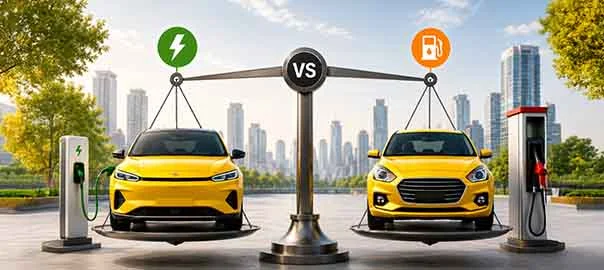
The first and most noticeable difference between the two vehicle options is their purchase cost. Electric car prices are usually higher than petrol cars because they feature sophisticated battery packs and other specialised components.
Take the Tata Nexon, for example:
| Vehicle Variant | Starting On-Road Price (Delhi) |
|---|---|
| Tata Nexon Petrol | ₹8.35 Lakh |
| Tata Nexon EV | ₹13.33 Lakh |
You can notice similar price differences across varying other vehicles featuring petrol and electric variants. The initial purchase price of most EVs may appear higher, but their low running costs can make them a cost-effective option in the long run.
Factors That Affect Electric Car Cost in India
Electric car costs are generally higher in India for mid-level and advanced variants. However, you can find models at varying price levels. Their prices are determined by numerous factors, including –
Battery Pack Size and Technology
The battery takes up a massive portion of an EV’s price. If you’re choosing an EV with a larger battery pack designed to deliver a longer driving range, it’ll naturally cost more. Their underlying technology also influences costs because it directly affects manufacturing costs.
Features & Vehicle Segment
As with petrol cars, EV prices vary based on size, safety equipment, performance, connected features, and underlying technology. So, if you explore an entry-level electric hatchback and a premium electric SUV, you’ll find a massive difference in their prices.
Government Policies & Taxes
The biggest cost differentiator in the electric car vs petrol car debate is the applicable government policies and taxes. Petrol cars don’t receive any special government incentives, but EVs do. As of the revision announced based on the 56th GST Council meeting in September 2025, EVs are subject to only 5% GST, whereas regular petrol cars will attract 18% GST. People purchasing EVs are also eligible to claim tax benefits u/s 80EEB, if all applicable rules are met. Taken together, electric cars are much more attractive than petrol cars.
Government Subsidies and Tax Benefits for EV Buyers
As briefly touched upon in the previous section, electric car prices are lower due to numerous government subsidies and tax benefits. At a national level, the Central Government levies a 5% GST on EVs, which is far lower than the 18% GST rate applied to regular petrol (≤1200cc & ≤4000mm) and diesel (≤1500cc & ≤4000mm) cars.
In addition, you can find various subsidies and taxes approved by different Indian state governments. For example, in Maharashtra, all EVs enjoy a 100% exemption from both road taxes and the vehicle registration fees, which significantly lowers the on-road price of EVs. Maharashtra also provides direct subsidies for the purchase of electronic scooters, electronic bikes, and other electronic vehicles.
Anyone purchasing an electric car for commercial use, such as a taxi, receives a subsidy capped at ₹25,000. You can explore state-wise exemptions, subsidies, and other government benefits for EVs. It will help you get an accurate estimate of an electric car’s cost.
EV Charging Infrastructure in India
India’s EV charging infrastructure is expanding rapidly. However, it still hasn’t reached a level to support the government’s aspirational goal of achieving a 30% share of total vehicle sales for EVs by 2030. However, efforts are still underway to accelerate the growth and development of EV charging infrastructure across the country.
In 2022, India had approximately 5,000 public EV charging stations, but this number increased to 29,000 in 2026, representing a near sixfold expansion in three years. If the government wants to achieve 30% EV penetration in vehicle sales by 2030, it will need to install around 1.32 million public charging stations, which is almost 40 times the current installed base.
Electric Car Savings Over The Long Term
People usually purchase EVs because they assume they’re a far more cost-effective option than petrol and diesel cars, but is that true? You can only enjoy electric car savings if you drive it consistently over several years. It’s crucial for cost savings, as lower maintenance and EV running costs gradually offset the higher purchase price.
Let’s calculate the estimated savings from electric cars using an example:
| Factor | Petrol SUV | Electric SUV (EV) |
|---|---|---|
| Fuel/Energy Cost | ₹100 per litre | ₹8 per unit (kWh) |
| Efficiency | 15 kmpl | 15 kWh per 100 km |
| Running Cost per km | ~₹6.7 per km | ~₹1.2 per km |
| Annual Cost (15,000 km) | ₹1,00,500 | ₹18,000 |
For someone driving 15,000 km annually, that’s a saving of approximately ₹80,000-₹85,000 on energy costs alone. We haven’t even factored in the lower servicing expenses. However, you can only save money if you drive long distances every day. Short-distance travel won’t give you the savings you’re expecting.
Electric Car Maintenance Cost vs Petrol Car Maintenance Cost
In terms of maintenance, EVs clearly win in the electric car vs petrol car debate. Since EVs feature a specialised battery pack and have far fewer moving parts, EV owners don’t have to spend money on engine oil changes, spark plugs, timing belts, clutch replacements, etc.
It significantly lowers their car maintenance costs. Routine servicing of EVs is also limited to software diagnostics, cabin filters, tyres, brake fluid, etc., which helps keep their overall maintenance costs manageable. You cannot say the same for petrol cars. Since petrol cars have multiple engine components working together to keep the vehicle moving, their maintenance costs are usually higher than those of EVs. The precise maintenance cost will depend on the type of service you avail yourself of, so there is no average cost that can be used for comparison.
Factors Affecting EV Efficiency in Indian Conditions
Although top EVs deliver high electric car mileage, their efficiency can fluctuate for the following reasons.
Extreme Temperatures & Pressure
High summer temperatures, especially in cities like Jaipur, Delhi, and Nagpur, can affect an EV’s battery performance and overall energy consumption. During extreme heat, the battery management system (BMS) may draw additional energy to keep the battery within its optimal operating temperature range. In extreme summers, the continuous use of AC can also increase overall power consumption. Together, these conditions may reduce the vehicle’s real-world driving range.
Driving Style & Traffic Conditions
If sudden hard braking and frequent acceleration are part of your driving style, they will directly impact your EV’s efficiency. Driving more often in stop-and-go traffic will further increase energy consumption, reducing the car’s mileage.
Vehicle Load and Road Conditions
Whether you’re driving a petrol car or an electric one, always ensure you don’t carry unnecessary luggage on every trip. This extra vehicle load requires more energy to move the vehicle, affecting the car’s overall efficiency. The same goes for the road conditions. When you drive on steep inclines or uneven terrain, your EV consumes more electricity per kilometre. Over time, it results in reduced efficiency.
Engine Maintenance and Wear-And-Tear Expenses
One of the most significant differences in ownership costs comes from vehicle maintenance. If you own a petrol car, you’ll need periodic engine oil changes, oil filter replacements, transmission servicing, and other maintenance expenses to keep the car in good working condition. These recurring expenses continue to increase as the vehicle ages. EVs have an edge here because they can skip many maintenance expenses associated with a regular combustion engine and its components. As EVs have far fewer components than petrol cars, the wear-and-tear expenses are also comparatively lower.
Is EV the Best Option for Daily Commuters?
EVs can be the best option for daily commuters in India if their travel routes have adequate public EV charging stations. Using EV also emerges as a smarter travel option if you regularly travel long distances for work and want to keep the running costs lower. Although it’s a great travel option, it may not be ideal for everyone. If you’re someone who regularly undertakes long-distance highway journeys and lacks access to reliable home or workplace EV charging infrastructure, then a petrol car emerges as a better option.
Conclusion
The real cost of owning a car extends far beyond the ex-showroom price. Once you explore the components included in a car’s on-road price and evaluate their recurring maintenance expenses, you’ll get a true idea of a vehicle’s ownership cost. In this blog, we’ve shared the ownership costs of an electric car vs. a petrol car in India, so you can make a financially wiser choice for yourself. If you aren’t satisfied with the insurance component included in the car’s on-road price and want to explore a better insurance plan, then explore the different Car Insurance plans at Shriram General Insurance.
FAQs
1. Are electric cars expensive to maintain?
EVs are relatively inexpensive to maintain compared to other cars because they have fewer components that require frequent servicing.
2. Why are EVs in India more expensive than petrol cars?
EVs are usually priced higher than petrol cars because they feature advanced battery packs and other specialised car components.
3. Does the government provide any taxation relief to EV buyers?
Yes, it does. The Central Government charges only 5% GST on EVs, while petrol and diesel cars continue to attract 18% GST. Some EV buyers can also claim tax benefits u/s 80EEB.
4. Are EVs really cost-effective?
EVs are cost-effective due to their low running costs. However, you can only enjoy cost savings if you use it for long-distance travel over several years.
5. Can EVs replace petrol cars?
No, both have distinct advantages and purposes, so you cannot replace petrol cars with EVs.