New PUC Rules in India 2026: Validity, Fines, And Requirements
29 October,2026
Updated:29 October,2026
0 min read

share


Copied
 86
This blog shares the new pollution certificate rules for 2026. If you own a non-electric vehicle, you should know these new PUC rules.
India is set to become one of the fastest-growing large economies in 2026, but it’s still struggling to tackle its air pollution crisis. Despite numerous efforts, India’s air pollution levels continue to remain among the worst on the planet. According to a report, the country’s national average PM2.5 concentration was 48.9 µg/m³ in 2025.
It is nearly 10 times the WHO-recommended guidelines. Hence, the Indian government, along with CAQM and MoRTH, released stricter PUC certificate rules in 2026 to improve air quality. We’ve covered the new PUC rules in this blog, so ensure you read till the end.
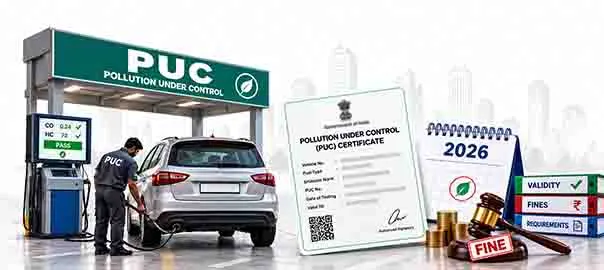
What is a Pollution Under Control (PUC) Certificate?
Also known as a pollution certificate, a PUC certificate is an official document confirming a vehicle’s exhaust emissions are within prescribed limits. You receive a PUC certificate from a government-authorised PUC testing centre.
Since every vehicle owner in India needs a valid PUC certificate for legal compliance, except EV owners, it’s as important as your vehicle’s RC, driving license, and vehicle insurance. It includes the vehicle’s registration number, the emission test’s date & time, the test results, and other key details.
New PUC Rules in India 2026: What Has Changed?
Merely having a pollution certificate in 2026 isn’t enough. You must know the latest rules governing it to ensure sustained legal compliance. In 2026, the government passed a ‘No PUC, No Fuel’ rule to ensure stricter compliance with permissible vehicular emissions.
Starting 1st October 2026, this rule became enforceable across all fuel stations in the Delhi-NCR region. Under this pollution certificate rule, fuel stations can deny you fuel if you don’t have a valid PUC certificate.
However, this rule isn’t applicable nationwide; it applies only in the Delhi-NCR region. So, even if your car is registered in a different state, you may be refused fuel without a PUC certificate if you’re travelling in this location.
The government is also considering a proposal to extend the PUC validity of BS-VI private vehicles aged up to 6 years to 3 years, instead of the current 1-year limit. If it becomes a rule, it could bring immense relief to new vehicle owners.
PUC Validity in India: How Long Is a Certificate Valid?
The PUC validity varies depending on the vehicle’s age, type, and emission standard. Newly purchased vehicles, both private and commercial, come with a PUC certificate that’s valid for up to 1 year. After the first year, you must renew it annually.
Older vehicles that still follow the BS-IV, BS-III, or BS-II emission standards must renew their pollution certificate more frequently, i.e., every 3 or 6 months, depending on their age. The government is considering extending PUC validity for vehicle owners’ convenience. Once applicable, the following validity duration will become standard –
| Emission Standard | Vehicle Age | PUC Validity & Renewal Timeline |
|---|---|---|
| Private BS-VI Vehicles | Up to 6 Years | 3 Years |
| Private BS-VI Vehicles | Aged 6 to 10 Years | 1 Year; annual renewal is required |
| Private BS-VI Vehicles | Older than 10 Years | Renewal every 6 months |
| Private BS-IV Vehicles | - | Renewal required every 6 months |
| Private BS-I to BS-III Vehicles | - | Renewal required every 3 months |
| BS-VI Commercial Vehicles | Up to 6 Years | 2 Years; |
| BS-VI Commercial Vehicles | Aged 6+ Years | Annual renewal is mandatory |
Pollution Certificate Rules for New Cars and Two-Wheelers
Newly purchased cars and two-wheelers don’t require a pollution certificate for the first 12 months. After one year from the vehicle’s registration date, you’ll need to renew it as per the standard norms.
We have already covered PUC validity and renewal requirements in a previous section; you can refer to it for clarity. Since it’s mandatory, ensure you carry the certificate at all times while driving. Traffic authorities may check it to ensure legal compliance.
How to Get or Renew a PUC Certificate
You don’t need a PUC certificate for a brand-new vehicle at purchase, as the manufacturer/dealership usually provides it. It’s valid for the first 12 months. Once this period expires, you’ll need to renew the certificate as per the 2026 PUC rules. To renew, you’ll first need to find an authorised PUC centre.
You can find it on the Ministry of Road Transport & Highways website under the ‘PUC Centre List’ tab. Select your state and office from the dropdown, and you’ll see a list of government-authorised PUC centres.
Choose the nearest centre and take your vehicle there for testing. Once the operator conducts the emission test, you can wait for the result. If the emissions are within the permissible limit, the certificate will be renewed successfully.
What Documents Are Required for a PUC Certificate?
You don’t need numerous documents to get a pollution certificate in 2026. When you visit the authorised PUC testing centre to renew your certificate, simply carry your car’s registration number/certificate, as it contains all the details a PUC testing centre may require.
If you have your old/expired PUC certificate, you might carry it as well for convenience. However, it’s best to contact your chosen PUC testing centre for confirmation, as some centres may require additional documents.
How is a Vehicle’s Pollution Level Tested?
Once you take your vehicle to a testing centre, the operator will use specialised equipment to measure specific gas concentrations and smoke density. For petrol/CNG/LPG vehicles, the operator measures carbon monoxide and hydrocarbon levels.
For diesel vehicles, they’ll primarily measure the exhaust smoke. Testing methods and steps may vary slightly from one testing centre to another. Hence, if you want to know the precise step-by-step testing method, it’s best to contact the testing centre for confirmation.
Penalty for Driving a Vehicle With an Invalid/Expired PUC Certificate
Non-compliance with the new PUC rules can attract hefty penalties. If you’re caught driving without a valid pollution certificate in 2026, you may face a fine of up to ₹10,000 and, in some cases, up to 6 months’ imprisonment.
Avoid tampering with the certificate for any reason, as fake/tampered certificates can also lead to vehicle seizure in addition to the aforesaid PUC fine in India.
What Happens If Your PUC Certificate Expires?
Once your PUC certificate expires, your vehicle officially becomes non-compliant with Section 190 (2) of the Motor Vehicles Act. Continuing to drive without timely renewal can attract penalties of up to ₹10,000 and, in some cases, imprisonment of up to six months.
We’ve already shared the certificate renewal steps in a previous section, so use them to renew the PUC certificate on time.
How to Check Your PUC Certificate Status Online?
You can check your PUC certificate status online within minutes. Simply follow the three steps mentioned below –
- Visit the Parivahan PUC portal and navigate to the ‘PUC Certificate’ tab.
- Enter your vehicle’s registration number and the last 5 characters of the chassis number.
- Enter the displayed CAPTCHA and click on ‘PUC Details.’
As you finish the 3rd step, the screen will display the PUC certificate details, including the current status.
Conclusion
Having a valid pollution certificate in 2026 is a legal requirement that Indian vehicle owners must comply with. It certifies that your vehicle’s emission levels are within permissible limits. If you own a vehicle or plan to buy one, make sure you’re aware of all the new PUC rules covered in this blog.
Since insurance is another mandatory requirement, ensure you cover your vehicle under a relevant insurance policy. You can explore the Car Insurance plans available at Shriram General Insurance. We provide third-party, comprehensive, and standalone own-damage car insurance plans to accommodate varying coverage needs.
FAQs
Is a pollution certificate mandatory for every vehicle type or only commercial vehicles?
A pollution certificate is mandatory for every vehicle type, except electric vehicles. Whether you own a private car or two-wheeler or a fleet of commercial trucks, you’ll need a valid pollution certificate for every vehicle.
What if I don’t renew my pollution certificate on time?
If traffic authorities catch you driving without a valid pollution certificate, then you can attract a penalty of up to ₹10,000. In some cases, you may also face up to 6 months of imprisonment.
Do all vehicles require annual renewal of their PUC certificate?
No, the renewal timeline is determined based on the vehicle’s age, type, and emission standards.
Where do I get my car tested for a PUC certificate?
You can get the car tested at a government-authorised testing centre. You can find one by visiting the Parivahan PUC portal. A state-wise list is available under the ‘PUC Centre List’ tab.
What documents do I need to get a PUC certificate?
You don’t need several documents to get a PUC certificate. Your vehicle’s registration certificate is sufficient, as it contains all the key details that a government-authorised testing centre may need.