


How to Check Car Tyre Pressure at Home for Better Safety and Mileage
17 September,2026
Updated:17 September,2026
0 min read

share


Copied
 20
20This car tyre pressure guide lists steps to measure your car’s tyre air pressure at home. It also covers warning signs, measurement tools, ideal tyre pressure settings, and more.
A car’s tyres may not get your attention until they start affecting the driving experience. Sometimes, even perfectly looking tyres may be running on lower pressure than recommended, affecting how the car brakes, corners, and consumes fuel.
Both underinflated and overinflated tyres are dangerous, which is why car owners should routinely check their vehicle’s tyre pressure before driving. If you’ve never done it before, use the steps discussed in this tyre pressure guide to measure car tyre pressure at home.
Why Correct Car Tyre Pressure Matters for Safety and Mileage
Your car’s tyre pressure affects both safety and mileage. If the pressure is either lower or higher than the recommended levels, then the car becomes more vulnerable to road accidents. The correct car tyre pressure matters for safety and mileage because it –
Helps Maintain Braking & Handling Control
Tyre pressure affects how much of the tyre contacts the road and how it responds to steering and braking inputs. Underinflated tyres become less responsive, particularly during sudden braking, cornering, or quick manoeuvres. It affects overall vehicle control, increasing the likelihood of a road accident/collision.
Reduces Unnecessary Rolling Resistance
A tyre that’s significantly underinflated deforms more as it rolls, increasing rolling resistance. In such cases, the engine needs to work harder to move the car, consuming more fuel than needed. Hence, if you’re concerned about maintaining your car’s mileage, make it a habit to check your car’s tyres at home.
Promotes More Even Tyre Wear
Extremely high or low tyre pressure can affect how the tyre’s tread meets the road. If your car’s tyre air pressure is much lower than recommended levels, it will cause greater wear along the tyre’s outer edges.
With excessive pressure, wear concentrates toward the centre. Maintaining the recommended car tyre air pressure helps the tread wear more evenly.
Signs of Low Tyre Pressure You Shouldn’t Ignore
Even if you can’t routinely check car tyres at home, you should at least keep looking for visible signs of low tyre pressure. The following signs are usually the most common in underinflated tyres.
- A visibly sagging sidewall
- A tyre appearing flatter than others
- Steering suddenly feels heavier
- Gradual drop in mileage
- Tyre Pressure Monitoring System (TPMS) warning light starts flashing
- Uneven tread wear
Disclaimer: These are merely signs associated with low tyre pressure; they don’t guarantee low pressure. Always have a mechanic measure your car tyre pressure, or check it yourself with a reliable tool, to confirm whether the pressure is below the recommended level. This matters because the signs above can also come from other car problems.
Step-by-Step Guide to Check Tyre Pressure at Home
If you want to check your car’s tyre pressure for mileage and safety, then follow the steps listed below.
Check When the Tyres Are at Rest
Never check tyre pressure if the car has just been driven. Driving temporarily heats the tyres, which may influence the pressure reading. For an accurate reading, measure pressure before driving or after the car has been parked for several hours.
Find the Recommended Pressure
Before you choose a tool to measure your car’s tyre pressure, find the ideal pressure level, as not every car model has the same recommended pressure.
Even rear and front wheels may have different ideal pressure levels. So, first check the owner’s manual, or look for the manufacturer-provided label that lists your car’s recommended tyre pressure.
Remove the Valve Cap
Once you’ve identified the ideal tyre pressure for mileage and safety, grab the pressure-reading tool and unscrew the cap from each tyre’s valve stem. Keep it somewhere clean and nearby to avoid losing it.
Take the Pressure Reading
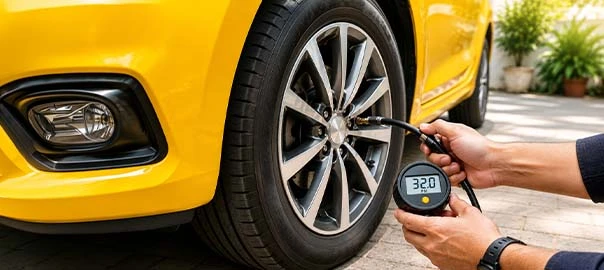
For this step, you can use any tool you prefer. Beginners can use a digital tyre pressure gauge for its ease of use. Once you’re ready with the tool, press the gauge firmly against the valve stem until you get a stable reading. Check all four tyres individually, as their pressure may differ.
Compare & Adjust
If a tyre is below the recommended pressure level, add air and recheck the new pressure level with the gauge. Similarly, if a tyre is overinflated, then gently release the excess air and measure again.
Refit the Valve Caps
Once each tyre has reached the correct pressure, securely refit the valve caps.
Best Tyre Pressure Settings for Your Car
There is no fixed tyre pressure setting that’s ideal for every car because the vehicle manufacturer determines it based on the car’s tyre size, load, and handling characteristics. For example, the ideal tyre pressure for a Maruti Suzuki Alto 800 is 29 PSI, while it’s 36 PSI for a Hyundai Creta.
You may also find variations in the ideal pressure setting for the rear and front wheels. For instance, the ideal pressure for a Maruti Suzuki Swift’s front tyre is 36 PSI, whereas the ideal pressure for its rear tyre is 33 PSI. So, we recommend checking the ideal tyre pressure setting for your specific car model.
You’ll find it in the owner’s manual or driver-side door pillar. Always follow the manufacturer specifications rather than using the maximum pressure printed on the tyre’s sidewall.
How Tyre Pressure Monitoring Systems Help
You can rely on the Tyre Pressure Monitoring System (TPMS) installed in your car to stay updated on the tyre’s current pressure level. These systems use advanced sensors for monitoring tyre pressure at all times, and alert the driver when the pressure falls below the vehicle manufacturer’s recommended levels.
It makes it easier to identify pressure loss that may not be visible immediately. TPMS is particularly useful because a car’s tyre may lose pressure gradually without producing obvious changes in handling, steering, braking, etc.
While it’s useful, it doesn’t replace the need for manual checks. Sometimes, it may not warn you immediately about every gradual pressure change, and the system itself might develop sensor or battery-related faults, resulting in incorrect readings. So drivers should still check car tyre pressure routinely with a reliable pressure gauge for safety reasons.
Recommended Tools to Check Tyre Pressure Accurately
If you’re looking for the best tyre pressure measurement tools, explore the following recommendations.
Digital Tyre Pressure Gauge
A digital tyre pressure gauge is one of the simplest tools to measure car tyre pressure for beginners. It’s compact, easy to use, and gives a clear numerical reading.
Analogue Tyre Pressure Gauge
Another great tool, it features a mechanical dial to show tyre pressure. Since it doesn’t require batteries, you can rely on it during long, multi-day road trips or when a digital gauge runs out of battery.
Portable Tyre Inflator
This tool serves a dual purpose: measuring tyre pressure in real time and filling air in underinflated tyres to reach recommended tyre pressure levels. Look for portable electric tyre inflators with a built-in digital pressure display.
Models with automatic shut-off are particularly convenient because they detect the air pressure and add air until the target pressure is reached. Once the optimal pressure level is reached, the inflator will automatically stop.
How Weather Affects Your Car’s Tyre Pressure
It can be surprising to many, but weather can affect your car’s tyre pressure in the following ways –
Cold Weather Can Lower Air Pressure
When temperatures fall, the air inside your car’s tyres may contract, lowering pressure. As a result, tyres may show a lower reading on colder mornings or in winter, even if there isn’t an air leak.
Hot Weather Can Raise Pressure
Consistently higher temperatures can increase the pressure of the air inside your tyres. If you’re driving long distances in extremely hot weather, it may add further heat. Taking pressure readings immediately after driving in such cases will usually show a higher reading than normal.
Sudden Temperature Changes Can Alter Readings
Sometimes a sharp change between daytime and nighttime temperatures can cause noticeable pressure fluctuations. Hence, a tyre correctly inflated during a warm afternoon may show a lower reading the following morning. Regular checks can help you account for these seasonal variations.
Hot Roads Add to Tyre Heating
In India’s summer months, road surfaces can become extremely hot. It can add to the heat generated inside tyres during driving. Since the pressure increase is temporary in such cases, you should avoid measuring pressure right after driving on hot road surfaces.
Conclusion
Routine tyre pressure measurement is one of the most crucial maintenance tasks that every car owner should prioritise. It’s directly linked to driving safety and mileage. If car tyres are underinflated or overinflated, they may affect steering and other driving controls.
We’ve shared steps to check car tyre pressure at home and a list of recommended tools in this blog, so use them to get accurate readings. If you’re also concerned about your car’s financial safety, then secure it under our Comprehensive Car Insurance plan. It provides all-round coverage plus coverage personalisation through add-ons.
FAQs
1. How frequently should I check my car’s tyre pressure?
You can check it once a month and before going on long road trips. It’s also worth checking if you notice signs of low tyre pressure, such as a visibly flat appearance, uneven tread wear, a sagging sidewall, etc.
2. Which is the best tool to measure a car’s tyre pressure?
A digital tyre pressure gauge is one of the best tools because it gives a clear numerical reading so you don’t have to guess the pressure level.
3. Is Tyre Pressure Monitoring System (TPMS) enough to find a car’s tyre pressure levels?
While TPMS keeps you updated on your car’s tyre pressure levels, you shouldn’t use it as a replacement for manual pressure checks. Although useful, it’s still a system that may malfunction at some time, giving you slightly inaccurate readings. Make it a routine to check your car’s tyre pressure level at least once a month and before every long road trip.
4. Can low tyre pressure reduce my car’s mileage?
Yes, it can. When your car’s tyre runs on significantly lower air pressure than recommended, it creates higher rolling resistance. As a result, your car’s engine will consume more fuel than usual to move the vehicle, reducing mileage.
5. Can I check my car’s tyre pressure at home?
Yes, you can. Ensure you have a good-quality digital tyre pressure gauge at home for easy readings.