

Highest Road Tax in India 2026: Which State Tops the List
26 June,2026
Updated:30 September,2026
0 min read

share


Copied
 5839
5839This blog shares state-wise road tax rates in India, along with other key details, so you’re fully aware of the road tax system in India.
When buying a car, people usually don’t think about road tax first. The primary focus is on the car specifications, including mileage, key features, and safety rating. However, it warrants attention during the pre-purchase phase because it’s an integral part of a vehicle’s on-road price.
You will have to pay road tax in India for legal compliance and to drive your car freely on Indian roads. This blog covers the applicable rules and rates for road tax on cars in India, so you know what to expect when purchasing and registering a car.
Understanding Road Tax in India: A Quick Overview
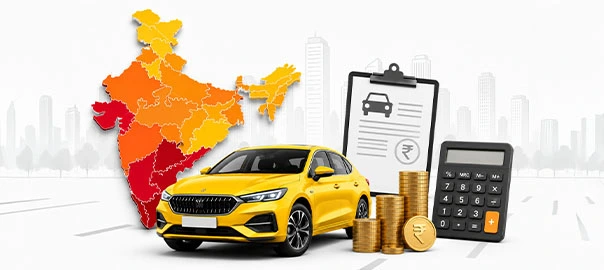
Road tax in India is a mandatory tax charged by state governments on vehicles that use public roads. It’s usually paid at the time of vehicle registration and is one of the key components of a vehicle’s on-road price. Since state governments set road tax rates, they aren’t uniform across the country. As a result, the same car can have widely different on-road prices due to variations in the road tax component. Anyone planning to purchase a new car should be aware of the 2026 road tax rules and rates to ensure a smooth ownership experience. We’ve covered both in the later sections.
Why Road Tax Matters for Vehicle Owners
Road tax in India matters to vehicle owners because it directly affects the cost of ownership. It’s collected upfront during vehicle registration and can easily add thousands, even lakhs, of rupees to the car’s final purchase price. Beyond this direct financial impact, paying road tax for cars in India is also a legal requirement that cannot be avoided.
Importance of Road Tax for Cars in India
Not many people clearly understand the importance of road tax for cars in India. The following points will clarify the relevance of road tax for cars.
Supports Road Infrastructure Development
Road tax is an important revenue source for state governments. They use these funds to facilitate the development, maintenance, and improvement of roads. Road tax collection also maintains other transportation infrastructure.
Required for Legal Compliance
Every vehicle must be legally registered for road use, and this registration can be done by paying the state-specific road tax.
Contributes to Road Safety & Amenities
The road tax you pay directly finances the essential facilities that keep commuters safe. We’re talking about amenities, such as streetlights, pedestrian footpaths, clear road signs, and more. It also makes your road journey safer and smoother.
Who Needs to Pay for Road Tax in India?
Vehicle owners must pay for road tax in India. Whether you own a two-wheeler or a four-wheeler, a personal vehicle or a commercial one, you’ll have to pay road tax as part of vehicle registration. It’s also a part of the car registration rules that you cannot ignore. The amount individuals pay as road taxes is eventually used to improve their road driving experience by maintaining transportation infrastructure.
How Road Tax Contributes to Infrastructure Development
State governments use the collected road tax for infrastructure development. Here’s how it’s used to improve the existing road infrastructure.
Funds Road Construction Projects
The road tax amount helps authorities build new roads, highways, flyovers, and bypasses. It significantly improves connectivity between cities, towns, and other locations.
Supports Maintenance & Repairs
Roads require continuous upkeep due to traffic, weather conditions, and regular wear. The road tax amount is used to support this maintenance and repair work, so roads remain usable and safe at all times.
Improves Traffic Management Infrastructure
The traffic signals, road markings, signboards, and intelligent traffic management systems that you notice throughout your road trips are all funded by the road tax amount.
Road Tax India 2026: Latest Rules, Updates, & Changes
Road tax in India in 2026 remains a state subject, allowing each state to have its own tax structure rather than a uniform rate. It has led to significant differences in vehicle registration costs across the country. As of 2026, Kerala and Karnataka charge the highest road tax in India, with Kerala charging up to 22% and Karnataka up to 18% road tax on new vehicles.
Another key update worth noting is that Karnataka has ended its previous 100% exemption rule for EVs, effective April 2026. Now, EVs will also attract road tax of up to 10%. The precise road tax rate will be determined based on the vehicle’s cost.
How is Road Tax for Cars Calculated in India?
There is no single, uniform formula followed to calculate road tax for cars in India. Although every state has its own tax structure, they usually calculate road taxes based on the vehicle’s cost.
The vehicle’s engine capacity, fuel type, and purpose (personal or commercial use) also influence the road tax calculation. Most states have a percentage-based rate tied to the vehicle’s value, which we have covered in a later section.
Factors Affecting Road Tax Charges
State governments use the following factors to determine car road tax in India in 2026.
Vehicle Value
The ex-showroom price is the biggest factor in calculating road tax. Many states follow value-based slabs. It means higher-priced vehicles are subject to a higher road tax rate.
Fuel Type
Several Indian states consider the vehicle’s fuel type before finalising the road tax rate. They usually categorise it into petrol, diesel, CNG, and EV. Diesel vehicles generally attract the highest road tax in India, while EVs enjoy concessions.
Vehicle Category
Private and commercial vehicles are taxed differently. Commercial vehicles usually pay higher road tax than personal, private vehicles.
Engine Capacity
Some states use engine displacement as a factor when calculating road tax. Vehicles with larger engines may attract higher taxes than smaller ones.
Ownership Type
You’ll find different tax structures for individually owned and company-owned vehicles. Vehicles with corporate registrations pay higher road taxes.
State-Wise Road Tax in India
We’ve shared the state-wise road tax in India in the following table. You can use it to estimate the on-road price of a car in India in 2026.
Note: These road tax rates are for private, non-commercial cars. Utmost care has been taken to reflect the accurate road tax rates, but they’re subject to change at any time at the government’s discretion.
| State | Vehicle Value | Road Tax Rate (% of Vehicle Cost) | Additional Notes |
|---|---|---|---|
| Andhra Pradesh | Under ₹5 Lakh | 13% | EVs are 100% tax exempt, except hybrids |
| ₹5 Lakh to Under ₹10 Lakh | 14% | ||
| ₹10 Lakh to ₹20 Lakh | 17% | ||
| Above ₹20 Lakh | 18% | ||
| Assam | Under ₹10 Lakh | 3%- 4% | EVs are exempt from road tax, and a 1% cess is charged for the first registration of a vehicle |
| ₹10 Lakh to ₹15 Lakh | 4% | ||
| Above ₹15 Lakh | 5%-7% | ||
| Bihar | Up to ₹8 Lakh | 8%-9% | Electric-based four-wheelers get a 75% tax rebate, so EVs pay 25% of the regular road tax |
| ₹8 Lakh to ₹15 Lakh | 10% | ||
| Above ₹15 Lakh | 12% | ||
| Chhattisgarh | Up to ₹5 Lakh | 5% | - |
| Above ₹5 Lakh | 6% | ||
| Goa | Up to ₹6 Lakh | 9% | EVs and hybrids have a similar tax structure |
| ₹6 Lakh to ₹10 Lakh | 11% | ||
| ₹10 Lakh to ₹15 Lakh | 11%-13% | ||
| Above ₹15 Lakh to ₹35 Lakh | 13% | ||
| Above ₹35 Lakh | 14% | ||
| Gujarat | All private, non-transport vehicles | 6% | Imported cars pay double the road tax; an exception applies if the vehicle is imported for individuals with disabilities. |
| Haryana | Up to ₹6 Lakh | 5% | - |
| ₹6 Lakh to ₹20 Lakh | 8% | ||
| Above ₹20 Lakh | 10% | ||
| Himachal Pradesh | Up to ₹15 Lakh | 6% | - |
| Above ₹15 Lakh | 7% | ||
| Jharkhand | Up to ₹15 Lakh | 6% | - |
| Above ₹15 Lakh | 15% | ||
| Karnataka | Up to ₹5 Lakh | 13% | EVs previously enjoyed 100% road tax exemption; this exemption has been revoked starting April 2026 |
| ₹5 Lakh to ₹10 Lakh | 14% | ||
| ₹10 Lakh to ₹20 Lakh | 17% | ||
| Above ₹20 Lakh | 18% | ||
| Kerala | Up to ₹5 Lakh | 10% | EVs have a road tax slab rate of 5% to 10% |
| ₹5 Lakh to ₹10 Lakh | 13% | ||
| ₹10 Lakh to ₹15 Lakh | 15% | ||
| ₹15 Lakh to ₹20 Lakh | 17% | ||
| Above ₹20 Lakh | 22% | ||
| Madhya Pradesh | Under ₹10 Lakh | 8% (Petrol/CNG) & 10% (Diesel) | EVs have a flat 4% road tax rate |
| ₹10 Lakh to ₹20 Lakh | 10% (Petrol) & 12% Diesel | ||
| Above ₹20 Lakh | 14% (Petrol) & 16% Diesel | ||
| Maharashtra | Under ₹10 Lakh | 8% (CNG), 11% (Petrol), & 13% (Diesel) | Cars under company registration attract a 20% road tax rate. |
| ₹10 Lakh to ₹20 Lakh | 8% (CNG), 12% (Petrol), & 14% (Diesel) | ||
| Above ₹20 Lakh | 13% (Petrol) & 15% (Diesel) | ||
| Manipur | Under ₹3 Lakh | 3% | - |
| ₹3 Lakh to ₹6 Lakh | 4% | ||
| ₹6 Lakh to ₹10 Lakh | 5% | ||
| ₹10 Lakh to ₹15 Lakh | 6% | ||
| ₹15 Lakh to ₹20 Lakh | 7% | ||
| Above ₹20 Lakh | 8% | ||
| Meghalaya | Up to ₹3 Lakh | 4% | You pay a fixed road tax every 5 years after the first 10 years. |
| ₹3 Lakh to ₹15 Lakh | 6% | ||
| ₹15 Lakh to ₹20 Lakh | 8% | ||
| Above ₹20 Lakh | 10% | ||
| Mizoram | Based on the car’s engine capacity | - | Fixed rate from ₹11,250 to ₹19,500 (depending on the car’s engine capacity) for newer cars less than one year old. |
| Nagaland | All personal cars | 5% | - |
| Odisha | Less than ₹5 Lakh | 6% | - |
| ₹5 Lakh to ₹10 Lakh | 8% | ||
| ₹10 Lakh to ₹20 Lakh | 10% | ||
| ₹20 Lakh to ₹40 Lakh | 12% | ||
| Above ₹40 Lakh | 20% | ||
| Punjab | Up to ₹15 Lakh | 9.5% | - |
| ₹15 Lakh to ₹15 Lakh | 12% | ||
| Above ₹25 Lakh | 13% | ||
| Rajasthan | Based on engine size | 6% to 10% (Petrol) & 8% to 12% (Diesel) | - |
| Sikkim | Based on engine capacity | Fixed slab rate (₹1,000 to ₹3,000) | Tax exemptions & low token taxes for EVs and hybrids |
| Tamil Nadu | Up to ₹6 Lakh | 9% | - |
| ₹6 Lakh to ₹10 Lakh | 12% | ||
| ₹10 Lakh to ₹20 Lakh | 18% | ||
| Above ₹20 Lakh | 20% | ||
| Telangana | Under ₹5 Lakh | 13% | This road tax rate applies to new four-wheelers less than one year old. |
| ₹5 Lakh to ₹10 Lakh | 14% | ||
| ₹10 Lakh to ₹20 Lakh | 17% | ||
| Above ₹20 Lakh | 18% | ||
| Tripura | Under ₹3 Lakh | ₹4,100 | This fixed road tax, based on the vehicle’s value, is a one-time tax applicable for the first 15 years. |
| ₹3 Lakh to ₹5 Lakh | ₹4,800 | ||
| ₹5 Lakh to ₹10 Lakh | ₹6,900 | ||
| ₹10 Lakh to ₹15 Lakh | ₹7,500 | ||
| Above ₹15 Lakh | ₹8,250 | ||
| Uttar Pradesh | Up to 6 Lakh | 3% | - |
| 6 Lakh to 10 Lakh | 6% | ||
| 10 Lakh to 20 Lakh | 8% | ||
| Above 20 Lakh | 9% | ||
| Uttarakhand | Up to 10 Lakh | 6% | - |
| Above 10 Lakh | 8% | ||
| West Bengal | Based on engine capacity | Fixed slab rate | ₹10,550 to ₹30,000 one-time tax for cars with engines ranging from under 900 cc to beyond 2500 cc |
Conclusion
Every vehicle owner in India has to pay road tax for legal compliance. Besides giving you the legal right to use public roads, road tax also helps maintain the existing road infrastructure. Since the road tax rate isn’t uniform across the country, we’ve shared state-wise road tax details in India. You can use it to estimate the on-road price of a car in India. Besides road tax, insurance is also a compulsory requirement for every vehicle owner. Hence, if you’re buying a new car, don’t forget to secure it under the Comprehensive Car Insurance plan at Shriram General Insurance.
FAQs
Which Indian states charge the highest road tax?
Kerala and Karnataka charge the highest road tax, with Kerala charging up to 22% and Karnataka charging up to 18%.
Do private vehicle owners also have to pay road taxes?
Yes, even private vehicle owners must have road taxes. It’s a legal requirement for every vehicle owner, regardless of your ownership status.
Do all Indian states charge the same road tax?
No, road taxes vary from one state to another.
How do Indian states calculate road taxes for cars?
There’s no uniform, standard formula to calculate road taxes. Each state has its own calculation process, but they all consider the vehicle’s cost, engine capacity, fuel type, etc., to determine the road tax.
When do I have to pay road taxes?
You generally pay it when registering the vehicle. Once the validity ends, you can renew it by making an online payment.