


Fuel Crisis 2026 CNG vs Petrol Which is the Best Choice for Car Owners
23 April,2026
Updated:30 September,2026
0 min read

share


Copied
 4252
4252This blog covers key details about different fuel types, petrol and CNG cars in India 2026, including their detailed comparison, so you can determine which is right for you.
Car owners in parts of the country were seen standing in long lines at petrol stations to fill their fuel tanks amid the recent fuel shortage. Although the government stabilised the fuel situation quickly, it left many car owners wondering how exposed they are to fuel-related uncertainty.
Even a small fluctuation in fuel prices or a shortage can affect their monthly fuel budget and routine. It made them wonder whether they can fully rely on petrol cars in India in 2026 or whether they should switch to CNG cars. This blog helps make this decision.
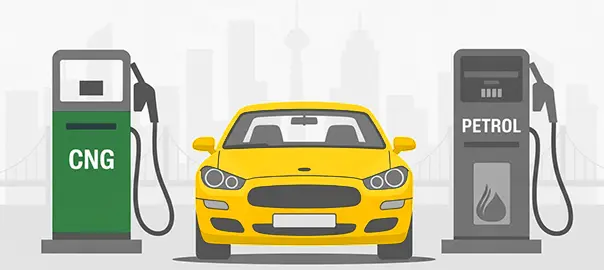
Reasons for the Fuel Crisis in India
Although brief, the fuel crisis in India sparked panic among car owners. If you’re unsure what created this crisis, the following points will clear your doubts.
Global Energy Instability
Political tensions in the Middle East, particularly around the Strait of Hormuz, triggered the crisis. It’s a narrow passage that handles 1/5th of the world’s crude supply. Hence, disruptions in this passage naturally halted the global crude supply. India imports nearly 85% of its crude oil, which is why the supply disruption was felt instantly across the country.
Price Volatility
During this period, global crude oil prices fluctuated sharply. In fact, the Brent crude crossed the US$100/barrel red line twice in March 2026. Since India’s petrol and diesel prices are linked to international crude rates, these price spikes led to slightly higher fuel costs, contributing to the crisis.
Public Panic Buying
The crisis-like situation further escalated at the ground level due to panic-driven demand rather than an actual fuel shortage. For instance, social media rumours about the fuel crisis led to 5-hour-long queues at petrol stations in Gujarat. The situation was brought under control after authorities assured a stable fuel supply.
What is a CNG Car?
A CNG car is a regular four-wheeler that runs on Compressed Natural Gas (CNG). These cars usually run on dual-fuel systems, which means you have more fuel options to rely on during crisis-like situations.
Since India imports only 46% of the CNG it consumes, compared to the massive 85% of crude oil imports, owning CNG cars in India in 2026 might appear to be a wiser option. Even if the petrol price in India spikes, you can still use your car like normal by using CNG.
What is a Petrol Car?
A petrol car is a regular car that runs on petrol. It relies on a spark-ignition gasoline engine for normal operation. In India in 2026, petrol cars remain the most common type of passenger vehicle.
Which is the Best Fuel for a Car Driver?
You can enjoy uninterrupted commute benefits if your four-wheeler runs on the best fuel for cars. Currently, the three best fuels for cars are petrol, diesel, and CNG. We’ve shared a detailed comparison of each, so you can identify the right fuel for your particular car.
| Basis of Differentiation | Petrol | Diesel | CNG |
|---|---|---|---|
| Fuel Cost | Petrol is the most expensive fuel but also the most common. The approximate petrol price (as of 19th April 2026 in Mumbai) was ₹103.54/L. | Diesel is moderately priced compared to petrol and CNG. The approximate diesel price (as of 19th April 2026 in Mumbai) was ₹90.03/L. | CNG is the least expensive fuel. The approximate CNG price (as of 19th April 2026) was ₹80.5/kg. |
| Practical Convenience | Petrol pumps are easily available across India, making refuelling quick and reliable | Diesel enjoys the same widespread availability as petrol | Although the country enjoys a good CNG station network, it isn’t easily accessible in every area |
| Driving Experience | Petrol delivers a smoother and more responsive driving experience | Diesel helps cars deliver stronger torque, making them better for highways and load-carrying drives | CNG cars deliver slightly lower power output, leading to slower acceleration |
| Boot Space Compromise | No compromise in the car’s boot space | No compromise in the car’s boot space | The car’s boot space gets affected as the CNG cylinder is placed in this area |
| Environmental Impact | High CO₂ emissions cause environmental pollution | Moderate emissions, but still not very environmentally friendly | Eco-friendly compared to both petrol and diesel |
CNG vs Petrol Mileage
If you’re comparing CNG and petrol as fuel options, you must assess their mileage to make an informed choice. The average mileage of CNG cars is typically between 18.55 km/kg and 26.55 km/kg. For petrol cars, the average mileage is 15-22 kmpl. This CNG vs petrol mileage difference should help you choose the fuel type that’s best for your car.
CNG vs Petrol Car: Key Differences
The recent fuel crisis in India prompted people to compare petrol cars with CNG options due to the greater availability of CNG. If you’re wondering whether to choose petrol or CNG cars in India in 2026, this comparison will help you make an informed decision.
| Basis of Differentiation | Petrol Cars | CNG Cars |
|---|---|---|
| Daily Running Cost | Petrol is the most expensive fuel option, so petrol cars naturally have high running costs | CNG is the least expensive fuel, which is why the running costs are significantly lower |
| Performance in Traffic | More responsive and easier to drive in mixed driving conditions | You might experience noticeable lag |
| Boot Space | Full boot space is available for usage | Boot space is reduced due to the CNG cylinder placement |
| Flexibility in Usage | High; you can use it smoothly without any challenges | Medium to low; proper route planning is needed to ensure CNG stations are available for quick refuelling |
| Engine Behaviour Over Time | Slightly higher carbon buildup over time | Cleaner combustion, potentially less engine wear |
| Engine Performance | Better acceleration, smoother pickup, and higher power output. | Slightly lower power output. Acceleration feels slower, especially with full load or AC |
| Ideal For | Petrol cars are ideal for people who prioritise performance, convenience, and flexibility | CNG cars are good for daily commuters, city drivers, and budget-conscious users |
CNG vs Petrol vs Diesel Cars: Pros and Cons
Whether you choose a CNG, diesel, or petrol car in India in 2026, you must make your decision by weighing each fuel’s pros and cons. This table will help you with clarity.
| CNG Cars | Petrol Cars | Diesel Cars | |
|---|---|---|---|
| Pros | ● Extremely low running cost ● Ideal for daily commuters ● Cleaner combustion ● Potentially longer engine life |
● Smooth driving experience ● Lowest upfront cost ● Wider charging station network ● Works well for all driving patterns |
● High fuel efficiency ● Strong torque makes highway driving easier ● Better suited for heavy usage and long-distance travel |
| Cons | ● Limited CNG station network outside major cities ● Reduced boot space lowers storage ● A slight drop in power affects performance |
● High fuel costs make it expensive for regular, long-distance travellers ● Slightly lower mileage compared to CNG and diesel cars |
● Higher upfront cost ● Expensive maintenance ● Not ideal for short-distance travel |
Which is Better: CNG or a Petrol Car?
There is no universal answer to it. Both CNG and petrol cars are uniquely better in their own ways. If you want to choose the right car for yourself, decide which car aligns more with your driving style and requirements.
Petrol cars in India 2026 are a common choice because they deliver a smooth driving experience and work well with almost every driving style. Their only downside is the high fuel cost, which can spike your monthly fuel expenses.
CNG cars in India 2026 are ideal for daily and long-distance travellers who prioritise low running costs. We’ve shared a detailed comparison of CNG and petrol cars in our previous sections, so check it to make an informed selection.
CNG vs Petrol: Fuel Cost Comparison
Fuel costs change regularly, so it’s challenging to get an accurate fuel estimate for CNG and petrol cars. Besides regular price changes, fuel prices also vary by location, so you must check the fuel cost for your current Indian city.
Overall, CNG is considered the least expensive fuel, while petrol is the most expensive. Hence, budget-conscious buyers should consider CNG cars, while those prioritising performance and convenience over high fuel cost can stick to petrol cars.
Conclusion
The recent fuel crisis in India has left many car owners uncertain about the future of fuel in India. Although the government quickly addressed and stabilised the crisis-like situation, it prompted some people to explore other fuel options that can be easily accessed if similar situations arise in the future.
In this blog, we’ve explored the best fuels for cars and shared a detailed comparison of petrol vs CNG cars. You can use this information to decide which fuel is better for your car. Similar to fuel, your choice of Car Insurance is also equally important. If you’re reevaluating insurance options, you must explore our Comprehensive Car Insurance plan from Shriram General Insurance. It provides enhanced coverage, plenty of add-on options, and affordable premiums.
FAQs
1. CNG or petrol: which is expensive?
If you’re exploring fuels based on price, petrol is the most expensive. CNG is the least expensive, making it attractive to budget-conscious drivers.
2. Which car delivers better mileage: petrol or CNG?
The mileage depends on the particular car model you choose. Although CNG cars are believed to provide better mileage, you can always find exceptions.
3. Will switching to a CNG car create any challenges?
Not really, but you might face some challenges due to limited availability of CNG stations. CNG charging infrastructure is growing rapidly, but its network isn’t as strong as petrol pumps yet.
4. What are the pros of choosing CNG cars?
The biggest pros include reduced fuel cost and lower carbon emissions.
5. Who should choose petrol cars?
Petrol cars are for anyone who prioritises a smooth driving experience and convenience over fuel costs.