Driving Without Valid Car Insurance Rules Fines And What You Need to Know
30 October,2026
Updated:30 October,2026
0 min read

share


Copied
 48
This blog shares the latest vehicle insurance rules and the penalties you may face for driving without insurance on Indian roads.
People usually buy motor insurance for a new vehicle on time, but renewals are easy to miss. A car insurance policy can expire without you realising it, especially if you miss renewal reminders for any reason.
Although it may seem like a simple paperwork lapse, it can leave you legally exposed and financially responsible for any resulting damage/loss to a third party and your own vehicle in a road accident.
We’re sharing the vehicle insurance rules and the consequences a vehicle owner may face for driving without insurance in India. This will encourage you to renew your insurance on time.
Why is Car Insurance Mandatory in India?
Section 146 of India’s Motor Vehicles Act makes car insurance mandatory. If you cannot purchase comprehensive insurance because of its comparatively high premiums, you should at least have a valid third-party insurance at all times. It’s the legal minimum every car owner must follow.
Car insurance is compulsory to protect people who suffer bodily injury, death, or property damage in a road accident. Without insurance, victims may struggle to receive rightful compensation from the at-fault driver.
Why Is It Illegal to Drive Without Valid Car Insurance?
Driving without insurance directly violates Section 146 of India’s Motor Vehicles Act. These vehicle insurance rules were drafted to protect people injured in a road accident and property owners whose property is damaged in an accident/collision.
So, if you keep driving without renewing your motor insurance on time, you’ll face hefty penalties and other legal consequences. We’ve covered more about it in the next section.
Driving without Insurance: Penalty in India
The Indian government has introduced hefty car insurance penalties to discourage vehicle owners from driving without insurance. Previously, first-time offenders could face a penalty of up to ₹2,000, while repeat offenders could be fined up to ₹4,000. Other legal consequences included up to 3 months of imprisonment.
However, recent amendments to the Jan Vishwas Act, 2026 have significantly increased the penalty amounts. As per these amendments, first-time offenders will pay a penalty of three times the base premium for their vehicles or ₹5,000, whichever is higher.
For second-time or repeat offenders, the penalty increases to five times the base premium or ₹10,000, whichever is higher. These rules come into effect from 15th August 2026, so you should prioritise timely insurance renewal.
What Happens if You’re Ever Caught Driving without Insurance?
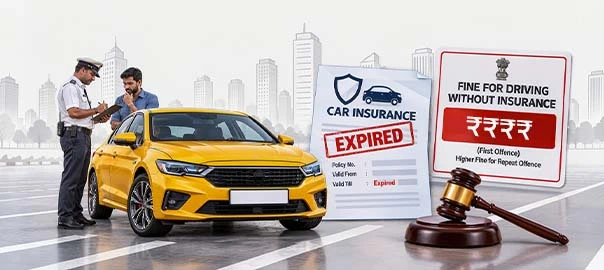
If you’re caught driving without valid insurance, then you’ll receive an insurance challan from traffic authorities. The fine depends on whether it’s your first offence or a repeat offence.
We’ve already covered the applicable car insurance penalty in the previous section, so you can refer to it for clarity. You’ll have to pay the challan at the earliest to avoid unwanted hassles in the future.
Insurance Challan: What Is It and How Does It Work?
In simple terms, an insurance challan is merely a fine or penalty notice issued by traffic authorities. You’ll receive this challan if you’re caught driving without valid car insurance. Traffic police can stop you at a traffic signal to check your insurance papers.
Even ANPR cameras installed on highways, city roads, etc., can monitor vehicles and cross-check their insurance status against the VAHAN portal database.
If your car is caught without valid insurance, an instant insurance challan will be issued in your name. The best way to avoid a car insurance fine is by ensuring timely car insurance renewal.
Does Driving Without Insurance Affect Your Vehicle Registration?
Although driving without insurance is a legal offence, it doesn’t automatically cancel or suspend your car’s registration in India. Vehicle registration and motor insurance are two separate legal requirements.
Hence, an expired insurance policy won’t, by itself, invalidate the vehicle’s Registration Certificate (RC) status. When you’re driving, carry both documents to pass any surprise traffic check.
What Happens if You Get into an Accident Without Insurance?
If your car is involved in an accident while its insurance is inactive or expired due to a failed renewal, you will be fully financially responsible for any resulting loss/damage. If you drive an uninsured car or one with expired insurance, you will have to pay from your own pocket to cover the losses/damages caused to all third parties and also your own vehicle.
You may also face legal proceedings arising from the accident as well as a separate penalty for driving without car insurance.
How to Check Whether Your Car Insurance is Valid
There are numerous ways to check your car insurance policy’s validity. We’re sharing a few simple ways for your convenience –
- Explore the Physical Insurance Papers
Check your policy papers for the validity period (start date and expiry date).
- Check the Status on Insurer’s Website
Visit the insurer’s website and log in using your ID and password. Once logged in, go to the existing policy tab to check the policy’s validity status.
- Explore the Validity on the Parivahan Portal
You can check the insurance validity status by visiting the Parivahan portal. Click on ‘Know Vehicle Details’ under the ‘Informational Services’ tab available on the homepage.
Enter your mobile number and complete the CAPTCHA verification to log in. Then enter the RC number and wait for the details to display on the screen. It usually includes the current insurance status.
Car Insurance Renewal: How to Avoid a Policy Lapse
The best way to avoid missing a timely car insurance renewal is to set renewal reminders in your personal calendar. Although your insurer will send multiple renewal reminders via email and SMS, setting alerts at least two weeks before the expiry date can help you avoid a lapse. You should also check whether an auto-payment or auto-renewal option is available. This can be incredibly useful for people with busy schedules.
Conclusion
If you’re driving any vehicle on Indian roads, you must follow all applicable rules under the Motor Vehicles Act. You cannot drive without a few crucial documents, such as insurance papers. If you get caught with expired car insurance, you’ll face hefty penalties and legal consequences.
Since vehicle insurance is crucial, make sure it’s always active. Remember the vehicle insurance rules shared in this blog to ensure ongoing legal compliance. If you’re looking for a reliable Car Insurance plan, explore our Third-Party, Comprehensive, and Standalone Own-Damage policies based on your coverage needs.
FAQs
Can I drive my car if the insurance has expired a day before?
No, you should avoid driving your car in such cases. A better option is to renew the policy online first, then drive your car.
What is the penalty for driving a car without insurance?
Previously, the penalty was up to ₹2,000 for a first offence and up to ₹4,000 for a repeat offence. After a recent amendment, the penalty for first-time offenders is ₹5,000 or three times the base premium, whichever is higher.
For repeat offenders, the penalty is ₹10,000 or five times the base premium, whichever is higher.
Is it compulsory to purchase comprehensive car insurance?
No, you don’t have to purchase comprehensive car insurance. Indian law requires you to buy at least third-party insurance to protect the compensation rights of those affected in road accidents.
You can choose comprehensive insurance if you want all-round protection for your car, not just legal compliance.
Can I renew my car insurance online?
Yes, you absolutely can. If your car insurance has expired, you can log in to your insurer’s website to renew your policy. Online renewals are usually faster and smoother.
Will driving without insurance lead to cancellation of my Registration Certificate (RC)?
No, your car’s insurance policy status has no direct effect on the RC. Driving without insurance has legal consequences, but it doesn’t lead to RC cancellation.