


Does AC Reduce Mileage? Myths vs Reality Explained
01 June,2026
Updated:30 September,2026
0 min read

share


Copied
 982
982People have conflicting opinions on whether car AC reduces mileage, which has led to several myths. This blog debunks all such common myths.
As a car owner, you will encounter various pieces of advice on using your car’s AC safely. Some people may advise you to avoid using the AC to save fuel, while others may argue that modern cars are smart enough to use fuel wisely.
So many opinions have divided people and led many to believe in myths as absolute truth. In this blog, we’re debunking common myths about car AC consumption and its impact on your car’s mileage. We’ve also debunked each myth, so you can make driving decisions without being influenced by false information.
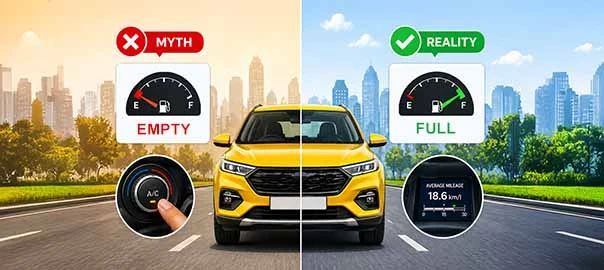
The Myths and Facts of Car AC and Mileage Reduction
Have you wondered if using your car’s AC can reduce mileage? With so many myths floating around, it’s easy to fall for them. Hence, we’ve debunked common myths about car AC consumption and its impact on mileage to help you drive more well-informed.
Myth 1: Using the AC Drastically Reduces Car Mileage
Reality: Although AC does require energy, the impact on mileage isn’t as dramatic. The precise impact will depend on multiple factors, including outside temperature, traffic conditions, vehicle type, trip length, and the extent to which the cooling system needs to work. The link between car AC and mileage can become apparent in very hot conditions and on short trips.
Myth 2: Keeping the Windows Open is Always Better Than Using the AC
Reality: It’s partly true. While you can notice some mileage improvements during city drives at slow speeds, the same isn’t true for highway drives. Trying to drive on highways with windows open will make the engine work harder due to aerodynamic drag. As a result, your car will burn more fuel even with the window open.
Myth 3: Modern Cars Don’t Lose Mileage When the AC is On
Reality: Modern cars have become more fuel-efficient over the years, but that doesn’t mean they don’t lose mileage due to car AC consumption. AC requires power, which comes from the engine. You may notice a slightly smaller impact of the AC on car mileage, but it will never be zero.
Myth 4: Setting the AC to the Coldest Temperatures Burns Much More Fuel
Reality: Some people assume that lowering the car’s AC temperature can instantly cause the engine to burn more fuel. In reality, the power required by your AC’s compressor for smooth operation depends on cabin cooling demand and system design. Extremely cold settings can make the system take longer to reach the target temperature, but simply choosing the lowest temperature doesn’t automatically lead to a massive increase in fuel consumption.
Myth 5: AC Only Affects Fuel Use While Driving
Reality: The AC can affect fuel consumption even when the car is standing still with the engine running. For example, if your car is idling in traffic or parked with the engine on, fuel will still be used to power the cooling system.
How Does a Car’s Air Conditioner Work?
Every car’s AC works using a simple mechanism. As you switch on your car’s AC, its compressor will release refrigerant into the cabin. This refrigerant circulates throughout the cabin, absorbing heat from the air inside your car and releasing it outside.
A fan then blows the cool air back into the cabin. It is how an AC keeps your cabin cooler throughout the drive. The car’s compressor draws power from the engine to operate smoothly, which is why you can notice a visible impact on mileage with AC use.
Does AC Affect Fuel Efficiency or Reduce Mileage?
Yes, AC does affect fuel efficiency and reduce mileage. Whether you drive an old petrol/diesel car or a modern one, its air conditioning system draws power from the engine to cool the cabin, affecting the car’s fuel efficiency.
However, you should know that the effect of the car’s AC on mileage isn’t the same in every situation. Fuel efficiency or mileage will be affected by numerous factors, including external temperature and driving conditions.
How to Save Fuel & Improve Mileage While Using AC: Smart Tips
Using your car’s AC doesn’t mean you have to accept unnecessary fuel loss. All you need is a few smart tips to reduce the cooling system’s load and improve the overall fuel efficiency. We’ve shared some of the most practical yet effective tips that can benefit every car owner.
Vent Out Trapped Hot Air Before Turning the AC to Maximum
If your car has been parked in direct sunlight for a long time, the cabin temperature will be much higher than the outside air temperature. In such cases, you shouldn’t immediately start the AC after entering the vehicle. Instead, open the car windows first so the trapped hot air can naturally escape, restoring the cabin temperature. This visibly simple step will reduce the burden on the car’s AC system, thereby preserving fuel efficiency.
Keep the Cabin’s Air Filter Clean
If the air filters inside your cabin get clogged, they will restrict airflow and reduce the AC system’s efficiency. When airflow drops, the cooling experience can feel less effective, often prompting drivers to increase AC use even more. Hence, always keep the cabin air filter clean, as it will help cool the cabin faster, reducing the need for extended AC use.
Park in Shaded Areas Whenever Possible
If you’re wondering how to save fuel while using the AC, try this simple tip. Always park your car in shaded areas or in spaces that don’t receive direct sunlight. It will keep your cabin temperature stable, making it easier for the AC to cool the space without requiring excessive power.
Use the Recirculation Mode After the Cabin Cools Down
Many drivers keep fresh-air mode running throughout the journey without realising it. Once the cabin is cool enough, you should switch to the AC’s recirculation mode. This setting will cool the already brisk air inside the car. As a result, your car’s AC won’t have to work as hard as before, improving fuel efficiency.
Car AC vs Open Windows: The Real Impact on Fuel Efficiency
Many car owners ask a similar question: Does a car’s AC reduce mileage in India? They also wonder whether opening the windows is better than using the AC to improve their car’s fuel efficiency. If you’ve had similar doubts, this section will provide the clarity you need.
Although the ‘car AC vs open windows’ debate has existed for years, there is no single winner for every driving situation. When you use your car’s AC, the engine provides the needed energy to power the cooling system. This additional energy demand can reduce fuel efficiency to some extent.
Some drivers try to reduce or eliminate this extra energy demand by driving with the windows open. What they don’t realise is that it creates another problem: increased aerodynamic drag, especially on highway drives. As air enters your car and moves through the cabin, it starts working against the direction your car is moving.
Hence, your engine ends up working even harder to continue driving against this aerodynamic drag, burning more fuel. So, driving with windows open and AC off isn’t the best option for highway driving. It can give you slightly better results during city rides at low speed because there is no aerodynamic drag in such cases. You can use this information to navigate the ‘car mileage with AC on vs off’ debate.
How to Improve Fuel Economy
If you’re looking for simple yet impactful tips to improve your car’s fuel economy in general, then stick to the following tips –
Maintain Proper Tyre Pressure
Avoid driving with underinflated tyres, as they can increase rolling resistance. It will make the engine work harder to move the vehicle, reducing fuel efficiency. You can avoid it by maintaining healthy tyre pressure at all times.
Remove Unnecessary Weight from the Car
Extra weight means extra effort for the vehicle. If you always carry excessive luggage while driving, your car’s engine will burn more fuel to keep it moving. Hence, only carry luggage that’s required. The improvement in fuel efficiency won’t be immediate, but you’ll notice it over time.
Keep Up with Routine Vehicle Maintenance
Every car owner should invest in routine vehicle maintenance, as it ensures that everything from engine oil quality to spark plugs is in good working condition. When your car is healthy, it will naturally maintain good fuel efficiency.
Conclusion
Myths about car AC reducing mileage aren’t new. They’ve been spread long enough to be accepted as reality by some people. However, modern car owners should be informed enough to distinguish between myths and facts. Hence, we’ve covered everything from why AC reduces car mileage in some cases to debunking myths around AC and mileage.
You can use this information to make better driving choices that can improve your overall driving experience. If you want to drive your car with a sense of financial security, ensure you secure it with a Comprehensive Car Insurance policy from Shriram General Insurance.
FAQs
1. Do open windows help improve fuel efficiency?
It depends. You can notice some improvements in fuel efficiency if you’re driving at slow speeds inside a city. However, there won’t be any improvement in the case of highway driving.
2. Can regular car servicing improve fuel economy?
Yes, it can. Routine car servicing keeps the vehicle in good condition, so it doesn’t burn unnecessary fuel.
3. Should I stop using AC to improve the car’s mileage?
No, it isn’t the best option. Not using AC won’t automatically improve your car’s mileage, especially if you frequently drive on highways.
4. Can car owners improve their vehicle’s fuel efficiency while using AC?
If you want to use AC and improve your car’s fuel efficiency, ensure you always park your car in shaded areas, get it serviced routinely, and maintain optimal tyre pressure at all times.
5. Does using AC while idling consume fuel?
Yes. If your car is stationary, but the engine is still on (mostly in stop-and-go traffic), your car will still consume fuel.