

Clutch Brake Accelerator in Cars Complete Guide to Understanding All Pedals
15 June,2026
Updated:30 September,2026
0 min read

share


Copied
 4517
4517This blog covers the key car pedal functions so every car owner knows how to use the clutch, brake, and accelerator safely.
For many new drivers, the most stressful part of learning to drive isn’t navigating chaotic traffic, steep turns, or packed parking spaces. It’s about using the clutch, brake, and accelerator correctly and at the right time without stopping the car every few minutes.
If you’re new to driving and are currently in the learning stage, it’s highly likely that you won’t have a clear understanding of all the key car pedals. Since this knowledge is necessary for safe driving, we’ve covered all the car driving basics related to pedals in this blog.
What are the Accelerator, Brake, & Clutch Pedals in Cars?
If you’re new to driving and trying to understand the basics of the key car pedals, including clutch, brake, and accelerator, then read ahead.
Accelerator
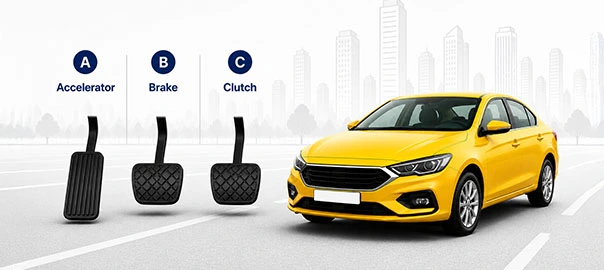
The accelerator is a crucial car pedal that helps you determine the speed of your car. You can use an accelerator to simply increase your car’s speed. Pressing this pedal increases the fuel and air supply to the engine, so your car can move forward at a higher speed. Press it lightly for steady movement, and press harder to increase the car’s speed more aggressively.
Brake
This pedal is designed to apply the brakes and stop the car. You can also use brake pedals to slow down your vehicle. Pressing the brake pedal creates hydraulic pressure to stop the wheels. Besides stopping your car, you can also use the brake pedal to manage your car’s speed in traffic.
Clutch
The clutch is generally the most confusing pedal for new drivers, yet the most important in manual cars. You’ll find it on the extreme left. The primary use of a clutch in a car is to temporarily disconnect the engine from the wheels so the driver can change gears more smoothly.
You should always use this pedal to shift gears if you don’t want to damage the gearbox. We encourage careful clutch usage as it can significantly improve your driving comfort.
The Best Way to Use the Clutch, Gear, and Brakes
Learning about the correct clutch, brake, and accelerator use isn’t enough. You should understand how all three car pedals work together in different situations.
Once you understand this coordination, the car starts feeling smoother and easier to control. We’ve shared the best way to use the clutch, gear, and brake pedal for an effortless driving experience.
Starting the Car Smoothly
One of the biggest mistakes beginners make is rushing the car forward from a standstill. As a car owner, you should know that smooth take-offs happen when the clutch and accelerator are balanced properly. The ideal process usually looks like this:
- Press the clutch fully
- Shift into first gear
- Slowly release the clutch to the biting point
- Gently apply accelerator input
- Continue releasing the clutch progressively
Patience is the key here. If you release the clutch too quickly before the engine has transferred enough power to the wheels, the car may jerk or stall.
Shifting Gears Properly
Gear changes should feel smooth, not abrupt. Every shift requires coordination between the accelerator, clutch, and gear lever. A proper upshift generally involves:
- Releasing the accelerator
- Pressing the clutch fully
- Shifting into the next gear
- Releasing the clutch smoothly
- Gradually accelerating again
Using clutch and accelerator at the right time and in the right sequence always leads to smooth gear shifts.
Braking Without Losing Control
If you press the clutch immediately before braking every time, then this point is for you. While this may prevent stalling at low speeds, it’s not always the best driving practice. In most situations, you should:
- Apply the brake first
- Let the car slow down naturally
- Press the clutch only when the RPM drops significantly, or the car is about to stop
This method allows the car to benefit from engine braking, which significantly improves the control and stability. You should also develop the habit of applying pressure progressively if you want each ride to become comfortable.
Handling Slow Traffic
Heavy traffic is where controlled clutch use in a car becomes especially more important. Constant clutch misuse in traffic is one of the main reasons clutch plates wear out early.
Even if you’re driving in slow-moving traffic, avoid keeping the clutch half-engaged by resting your foot on it. It can generate unnecessary heat and speed up the wear of your clutch plates. A better approach is controlled and minimal clutch usage for an improved driving experience.
What is the Function of the Clutch, Brake, and Accelerator in a Car?
Car pedal functions aren’t complicated for a beginner to understand. We’ve simplified it for your convenience.
Clutch
A clutch helps you shift gears smoothly. It’s designed to temporarily disconnect the engine, so gear-shifting doesn’t become harsh or damage the gearbox.
Brake
The main function of the brake pedal is to stop or slow the car. You can also use it to maintain a safe distance on the road and control speed during challenging turns.
Accelerator
The accelerator’s key function is to control how fast your car moves. Pressing the accelerator increases the fuel and air supply to the engine. It increases power output, allowing the car to accelerate.
Beginner Mistakes to Avoid While Using the Clutch, Brake, and Accelerator in Cars
Despite being aware of the car driving basics, including a foundational understanding of the key car pedals, some beginners make mistakes that disrupt their driving experience. We’ve shared the common mistakes beginners make so you don’t repeat them.
- Riding the Clutch: Many beginners keep their foot partially resting on the clutch pedal even when it’s not needed. It’s usually called ‘riding the clutch.’ We’d suggest avoiding it because it keeps the clutch partially engaged at all times. It generates more heat than required and can cause premature wear of the clutch plate.
- Releasing the Clutch Too Quickly: It’s another common mistake that causes erratic car movement or makes it stop completely. As a car owner, you should release the clutch progressively so that engine power transfers gradually to the wheels rather than abruptly.
- Excessive Accelerator Input: Some drivers over-accelerate while starting the car. It’s a costly mistake that puts excessive strain on the engine and even affects fuel efficiency. Manual car owners should gently apply throttle input and pair it with proper clutch control for smooth movement.
- Looking Down at the Pedals: New drivers tend to look down at the car pedals while driving instinctively. It’s extremely dangerous as it takes attention away from the road. If you’re underconfident about pedal usage, then drive on empty roads for practice. Continue this routine until you develop the muscle memory for the respective pedal positioning and use.
- Hard and Sudden Braking: Beginners sometimes react to traffic situations by abruptly hitting the brake pedal. It can unsettle the car and affect passenger comfort. Focus on applying controlled, progressive braking, as it delivers better balance and safer stopping performance.
Difference Between Manual and Automatic Car Pedals
While car pedals have the same function across different types of cars, they’re still widely different in manual and automatic cars. Here’s a quick glimpse into the key differences between manual and automatic car pedals.
| Basis of Differentiation | Manual Car Pedals | Automatic Car Pedals |
|---|---|---|
| Number of Pedals | Manual cars usually have three pedals, i.e., clutch, brake, and accelerator. | Automatic cars generally have two pedals – brake and accelerator. There is no clutch pedal because gear changes happen automatically. |
| Pedal Layout | You’ll typically find the clutch on the left, the brake in the middle, and the accelerator on the right. | The pedal layout is simpler. The brake is on the left, and the accelerator is on the right. |
| Driving Experience in Traffic | Stop-and-go traffic requires frequent clutch usage that can become tiring in crowded city areas. | Automatic cars deliver a more convenient experience because the driver doesn’t need to operate the clutch repeatedly. |
| Driver Involvement | Manual pedal operations require constant driver participation. | Driver involvement is slightly lower due to the automatic transmission system. |
| Fuel Efficiency Dependence | Car mileage depends heavily on the driver’s shifting habits, RPM management, and clutch usage. | Most modern automatic transmissions are highly fuel-efficient by design. |
Conclusion
No one can drive a car safely without fully understanding the key car pedals and their primary functions. Hence, we’ve explained car pedals in great depth in this blog. Use it as your beginner-friendly car pedals guide for educational purposes.
While the insights are helpful, we’d still recommend learning more about car pedals in practice from a certified trainer at a driving school. If you’ve recently purchased a new car or are about to buy one in the coming weeks, ensure you protect it fully by investing in the Comprehensive Car Insurance policy from Shriram General Insurance.
FAQs
1. Why is there no clutch in automatic cars?
You will not find a clutch in automatic cars because gears change automatically depending on the driving conditions.
2. Do all cars have the same number of pedals?
No. Manual cars have three pedals - clutch, brake, and accelerator. In contrast, automatic cars have only two pedals: brake and accelerator.
3.What happens if I release the clutch too quickly?
If you release the clutch too quickly, your car may exhibit erratic movement or the engine may stall.
4. Is hard braking a good driving habit?
No, it’s the opposite. Applying hard brakes can put extra strain on your car’s engine and even lower fuel efficiency.
5. Which is easier to drive: a manual or an automatic car?
Automatic cars are generally easier to drive because you don’t have to change gears manually.