

Car Inverter vs Power Bank: Which is More Useful?
29 June,2026
Updated:30 September,2026
0 min read

share


Copied
 545
545This blog provides a detailed comparison between a car inverter and a power bank to help you decide which option best suits your power needs.
Travelling is fun until you’re halfway through a road trip and most of your devices are already running low on power. Situations like these highlight the need for portable power solutions, such as a car inverter and a power bank.
If you have a road trip planned in the coming week(s) and can’t choose between the two, this blog is for you. It covers a detailed car inverter vs. power bank analysis so you can decide which is better.
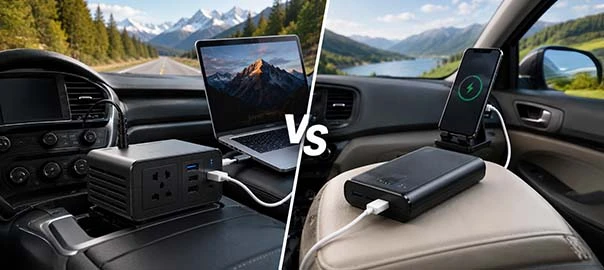
How is a Car Inverter Different from a Power Bank? A Quick Comparison Although both car power inverters and power banks for car travel are excellent portable power solutions, they’re designed to serve different needs and have very different purposes. This car inverter vs. power bank comparison will help you understand how a car inverter differs from a power bank.
| Basis of Differentiation | Car Inverter | Power Bank |
| Primary Function | You can use a car inverter to convert the car’s 12V DC power to AC power. It will let you charge all your electronic devices. | A power bank stores electricity in an internal battery. You can use this pre-stored energy through USB outputs to charge your devices. |
| Dependence on Vehicle | It requires a connection to your car’s battery and a 12V socket. | Works independently of the vehicle. |
| Devices It Can Power | It can power laptops, camera chargers, portable fans, small appliances, and other AC-powered devices within its wattage limit. | Best suited for smartphones, tablets, compatible laptops, smartwatches, and other small devices. |
| Runtime | Depends largely on the vehicle battery and whether the engine is running. | Limited to the energy stored in the power bank. |
| Power Output Capacity | Typically, it ranges from 150W to 1000W and higher, depending on the inverter’s model and size. | Power output is typically lower than that of car inverters, even if you purchase high-capacity models. |
| Best Use Case | Can fulfil all power requirements during long drives, road trips, outdoor work, camping, etc. | Ideal for low power requirements, especially for quick charging on the go. |
| Risk Factors | Excessive use can drain a car’s battery, especially when the engine is off. | Limited stored power can fall short of requirements during long travel. |
Need For Power Backup During Road Trip
Whether you’re going on a multi-day road trip or a long weekend trip, you’ll still need power backup to ensure a smooth journey. Here’s why power backup has become essential for road trips.
● More Travellers Are Carrying Power-Hungry Devices
Today, people usually travel with electronic devices, such as laptops, high-end cameras, tablets, and drones. All these devices consume far more power than a standard phone. If you want all electronic devices to remain functional throughout the trip, you must carry a portable power solution to keep them charged.
● Charging Opportunities Aren’t Available Everywhere
If you’re planning to travel in rural areas, on highways, or at campsites, you should be aware that you won’t have easy access to charging points. Having a dedicated power solution can save you during such situations. Besides reducing your dependence on external charging infrastructure, it will ensure all your devices are functional throughout the trip.
● Emergencies Rarely Arrive on a Full Battery
No one can predict an emergency, so it’s best to follow precautionary measures in advance. Even if you have your entire road trip planned, the travel time may be unexpectedly extended due to bad weather, a vehicle breakdown, or another unforeseen event. If you’re carrying a car power inverter or a power bank in your vehicle, you can use it to keep your electronic devices fully charged and operational for communication and navigation purposes.
How a Car Power Inverter Works
A car power inverter acts as a bridge between your car and the electronic devices you want to use. Most cars supply electricity at 12V DC, whereas most appliances are designed to run on AC power. A car inverter allows you to convert the vehicle’s 12V DC power into AC, enabling you to charge any electronic device. You only have to plug the inverter into your car’s 12V socket and use it like a regular charging point.
Advantage of Laptop Power Bank
People looking to carry a lightweight power solution for charging small devices can consider purchasing a laptop power bank. There are several advantages of carrying it, such as –
● Provides Power Even When You’re Away From the Vehicle
Unlike a car inverter, which requires access to your car’s battery and 12V socket, a laptop power bank does not rely on the vehicle for uninterrupted operation. You can use it even when you’re away from your car, such as at airports, cafés, campsites, hotel lobbies, and almost anywhere.
● Eliminates the Risk of Draining the Car Battery
Since a laptop power bank relies on its own pre-stored energy, your car’s battery remains preserved. It matters during long stops or emergencies where you cannot risk wasting the car’s starting power.
● Compact & Easy to Carry
Most laptop power banks are lightweight, making them easier to carry everywhere. Since they’re far more portable and lightweight than inverter-based setups, you can also carry them in your backpack, travel bag, etc.
Car Inverter vs. Power Bank: Which is Better?
This is a question most travellers have. Since not everyone wants to carry multiple power solutions, choosing between a car inverter and a power bank becomes necessary before each journey. For us, neither option is universally better, as both provide distinct advantages.
A car power inverter is a better choice if you usually carry multiple, power-consuming electronic devices on your trips. We’re talking about devices, such as laptops, camera equipment, portable fans, and other high-power devices. Although an inverter supports a wide range of devices, it relies entirely on the car’s battery.
However, if you’re only carrying lightweight, small devices, including smartphones, tablets, AirPods, and laptops, a power bank is enough for car travel. It’s far more portable, simpler, and independent of any external infrastructure.
Types of Inverters or Power Banks for Cars
There are different types of power banks and inverters for cars. We’ve covered the common types for your awareness.
Types of Car Inverters
- Modified Sine Wave Inverters: These are among the most affordable and commonly available car inverters. You can use it to charge basic electronic devices, such as small fans, phone chargers, and certain laptop chargers.
- Pure Sine Wave Inverters: Pure sine wave inverters produce electricity that closely resembles household power. They’re better suited for sensitive electronic devices, including high-end laptops, medical equipment, and advanced chargers. If smooth, reliable power matters more than budget, you should explore these inverters.
- Plug-In Car Inverters: Plug-in car inverters are the most compact option that can be directly connected to the vehicle’s 12V socket or cigarette lighter port. Since they’re designed for light-to-moderate power requirements, they’re popular among travellers who need a simple yet reliable power solution.
- Direct-Battery Car Inverters: You can connect these car inverters directly to your car’s battery for all high-power charging demands. They are more expensive than regular inverters, so people usually use them for long outdoor trips, camping, and remote work setups.
Types of Power Bank
- Standard USB Power Banks: These compact and affordable power banks are primarily designed for charging smartphones, wireless accessories, GPS units, and tablets. You can consider them for basic power needs during everyday travel.
- USB-C Power Delivery (PD) Laptop Power Banks: If you’re looking for a high-capacity power bank for car travel, then explore this option. They support USB-C power delivery technology, making it easier to charge compatible laptops alongside phones and tablets. It’s a rather reliable portable charging option for remote workers and frequent travellers.
- Jump-Starter Power Banks: A jump-starter power bank combines portable charging capabilities with emergency vehicle-starting functions. It means you can use it to charge your electronic devices and also generate enough power to start your car if the vehicle’s battery is fully drained. This dual functionality makes it ideal for long-distance travel.
- Portable Power Stations: These are widely different from the other power banks on this list. Larger in size, they feature significantly higher battery capacities. They also provide multiple output options, including AC outlets and USB ports to facilitate easy charging of different types of electronic devices. You should consider them for extended road trips, camping, and remote work setups.
Advantages of Using a Power Bank and a Car Inverter
Using a power bank and a car inverter has the following advantages –
- Keeps Essential Devices Powered Throughout the Trip: Many people rely on their smartphones for navigation apps during road trips, while others may require a laptop for longer periods for remote work. In such cases, it’s important to keep your devices powered up throughout the trip. You can do it using a power bank or a car inverter.
- Provides Greater Convenience on the Road: Having reliable power solutions on long trips can save you in road emergencies. You no longer have to rely on external charging infrastructure if your travel time gets extended due to bad weather conditions or a sudden vehicle breakdown.
- Ultimate Portability & Multi-Device Versatility: Both power banks and car inverters are portable, making them easier to carry on every road trip. Since most decent options support multi-device charging, you can rely on a single device to charge all your electronic devices.
Safety Tips While Using a Power Bank and an Inverter
If you’re planning to use an inverter for a car or a power bank for car travel, ensure you can follow these safety tips.
● Use Devices Within Their Recommended Power Limits
Every car inverter and power bank is designed to handle a specific power output. If you try to connect it to devices that exceed these limits, you may encounter overheating, reduced performance, or even equipment damage. Hence, always verify the power compatibility of the charger and the electronic devices.
● Avoid Excessive Heat Exposure
Longer exposure to high temperatures can damage battery health and affect the device’s performance. Hence, try to place portable power solutions away from direct sunlight. Don’t place them on hot dashboards or inside poorly ventilated areas for too long.
● Use Quality Cables
Never use damaged, low-quality, or incompatible charging cables to save money. It can cause unstable power delivery while increasing the risk of overheating. Always use high-quality, certified cables if you want to reduce the likelihood of electrical issues while travelling.
● Inspect Equipment Regularly for Signs of Damage
Every individual should conduct a routine equipment inspection. It will facilitate early detection of visible signs of damage. When checking, look for cracked casings, swollen batteries, loose connections, and unusual noises as they usually indicate equipment damage. If you notice any such signs, repair or replace the equipment.
Conclusion
As a traveller, you can always benefit from carrying portable power solutions. Confusion arises when people cannot choose among multiple options, e.g., a car inverter versus a power bank. Since both are good options, we’d suggest choosing one that fulfils your precise power needs.
We’ve shared a detailed analysis of car inverters vs power banks in this blog; you can use this information to choose the better option for you. If you’re also looking to secure your car under reliable Car Insurance coverage, consider exploring the Comprehensive Car Insurance plan at Shriram General Insurance.
FAQs
1. Can a car inverter charge a laptop?
Yes, you can use a car inverter to charge your laptop. Consider choosing a car inverter that’s compatible with your laptop’s power needs.
2. Can a power bank replace a car inverter?
No, you cannot replace a car inverter with a power bank, as both are designed for entirely different purposes.
3. Is a power bank safer to use than a car inverter?
Both are safe options if used correctly.
4. What devices can a power bank charge?
You can use a power bank to charge laptops, smartphones, AirPods, tablets, and other wireless accessories that require low- to medium-power charging.
5. Car inverter or power bank: which is better for a road trip?
It entirely depends on the type of devices you want to charge during the trip and their power requirements. Power banks are ideal for small electronic devices, and car inverters are better suited for more power-consuming electronics.