

10 Essential Items Every Car Owner Should Keep for Road Emergencies
23 September,2026
Updated:23 September,2026
0 min read

share


Copied
 11
11This blog lists all key car safety essentials that car owners must keep in their emergency kit at all times.
When you start your car to reach the office or begin your long-awaited road trip with friends, you don’t know whether your vehicle will break down midway due to engine failure or your tyres will fall flat. While no one can predict road emergencies like these, everyone can prepare in advance for convenience.
The best way to handle unexpected road emergencies is to carry a well-stocked car emergency kit at all times. We’ve covered the key emergency car items you must keep in this kit for safety and ease of navigation.
Why Every Car Needs a Roadside Emergency Kit
People may not realise the importance of carrying a road emergency kit unless they face unexpected road challenges. We believe this kit is useful because a sudden car breakdown can create two problems at once:
- The vehicle may stop functioning midway
- The driver can become vulnerable to surrounding traffic or changing road conditions
Travelling with a road trip safety kit can help you in both situations. Here’s how it will help you:
● Handling Minor Problems Independently
If your vehicle emergency kit has essentials like jumper cables, tyre inflators, and a pressure gauge, then you can handle minor issues independently without requiring immediate assistance. This saves time and avoids unnecessary hassle.
● Improving Visibility & Safety
This is another crucial yet less talked-about benefit. Car safety essentials like a warning triangle, reflective vest, and flashlight can make you more visible to other motorists at night. It can prevent road accidents/collisions.
● Buys You Time Until Help Arrives
Even when a problem requires professional assistance, having basic supplies can help you stay safe and comfortable on the road while waiting for professional assistance.
The key is to keep the roadside emergency kit practical, not excessive. You don’t need equipment for every potential mechanical failure. Focus on a few essentials that address common roadside situations and items you can safely use.
10 Car Safety Essentials for Daily Driving & Road Trips
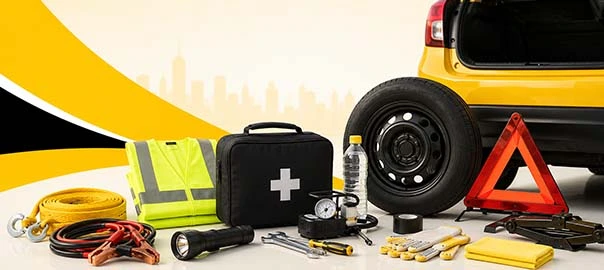
Whether you mainly drive around the city or frequently take long highway journeys, keeping a few basic safety items in your car can make common roadside problems easier to handle. If you’re unsure what to include in your road emergency kit, start with the following items.
1. Reflective Warning Triangle
You’ll need it if your car breaks down after sunset or in areas with poor visibility. A reflective warning triangle is a red triangular safety accessory that alerts oncoming drivers of a road hazard from a distance. Place it on the front or back of the stalled vehicle so drivers slow down or navigate around your car safely, avoiding potential collisions.
2. First Aid Kit
No roadside emergency kit is fully complete if it doesn’t have a well-stocked first aid kit, especially if you’re travelling with kids. You can use it to deal with minor cuts, scrapes, burns, or other small injuries that may occur during a road trip.
Consider keeping basic dressings, antiseptic supplies, bandages, pain relievers, and other common first-aid essentials inside. Be careful with this kit, since it contains items that require timely replacement when they expire. For this kit, make it a habit to check it occasionally and replace anything used or expired.
3. Power Bank
A power bank can be a surprisingly useful addition because it keeps your mobile phone and other necessary devices charged during long breakdowns. It can be particularly useful for people going on long, multi-day trips.
If your phone’s battery runs out of power, you can lose access to important contacts and navigation assistance when you need them most. A charged power bank can save you in such cases.
4. Portable Tyre Inflator with a Built-in Pressure Display
It’s a crucial emergency car item that serves a dual purpose: measuring the car’s tyre pressure and filling air to restore it to optimal levels. Consider getting a high-quality portable tyre inflator with a built-in digital display for pressure readings.
You can use it when the tyre’s air pressure leaks, creating rolling resistance and making it difficult to drive normally. It can make your journey smoother and safer.
5. Spare Wheel & Wheel-Changing Equipment
People driving on mountainous or rough terrains should always carry a spare wheel and wheel-changing equipment, such as a jack and wheel spanner. You can use them if a tyre punctures, so you can resume driving.
Before you attempt to replace a wheel, first move the car to a safer location. Also, remember to use the jack only at the manufacturer’s specified lifting point.
6. Portable Jump Starters
A portable jump starter is recommended because it can help you restart your car’s engine when its battery is too weak or gets completely discharged. Although some people carry jumper cables for the same reason, you should consider carrying a portable jump starter because it doesn’t rely on another car’s engine to draw power. It can benefit car owners who usually drive in remote locations.
7. Large Flashlight
All vehicle breakdowns are inconvenient, but breakdowns after sunset are particularly challenging due to poor visibility. Without sufficient light, you’ll struggle to inspect a tyre, locate tools, read instructions from a manual, or see around the vehicle.
A large flashlight can be incredibly useful in such cases. Choose a sturdy, large flashlight with adequate brightness for extra convenience.
8. High-Visibility Safety Vest
A high-visibility safety vest makes you easier to spot by other motorists on the road. Wear it if your car breaks down after sunset or stalls on a road with poor visibility. It improves visibility and helps prevent collisions.
9. Fire Extinguisher
Always carry a compact automotive fire extinguisher while travelling, as it provides an additional layer of protection. If a small, manageable fire breaks out for any reason while driving, you can use it to tackle the flames as you move away for safety and seek assistance.
Disclaimer: Never attempt to control a rapidly spreading fire that may put you in danger. In case of fire, always come out of the car and maintain a safe distance.
10.Collapsible Folding Shovel
Another essential for your car emergency kit, a collapsible folding shovel is a great addition for car owners who frequently drive on roads that get blocked by snow, loose mud, sand, etc. You can use it to clear these elements around the tyres, so you can drive safely.
Choose a collapsible yet sturdy folding shovel over a regular one because it takes up less boot space but still gets the job done.
Emergency Car Items for Breakdown Situations
If you’re looking for emergency car items that can help you specifically during breakdown situations, then carry the following items.
● Tow Rope
A heavy-duty tow rope can be useful when you need to move your stalled vehicle a short distance. Attach one end to your stalled car and the other to a vehicle capable of moving it. It should be in every car owner’s roadside emergency kit, as it can provide relief when professional towing services aren’t immediately available.
● Spare Fuses
Your roadside emergency kit should also include a few spare fuses that match the type and ratings specified for your car. These can be useful if a blown fuse disables a non-critical electrical function.
They take little space and can restore certain systems temporarily. Remember to carry fuses with the correct ratings, as replacing a blown fuse with an incorrect one can create serious electrical safety risks. Refer to your car’s manual to find the correct technical specifications.
● Wheel Chocks
A wheel chock can help prevent a stationary car from rolling when you’re working around it. You’ll need it particularly on slightly inclined road surfaces. Use it when you’re changing a wheel or carrying out a basic roadside check.
● Emergency Contact Card
Not all breakdown situations can be handled independently. If there’s a breakdown due to major engine failure, tyre burst, or electrical fault, it’s best to call for professional assistance. In such cases, a simple emergency card with contact details of mechanics, garages, and towing facilities can become your biggest saving grace.
Where to Buy Reliable Car Safety Products
Quality matters more when buying car safety products. If you want reliable products for your road trip safety kit, then purchase them from –
- Established auto parts stores
- Reputable automotive dealers
- Popular online marketplaces
You can also check the car manufacturer’s official website to see whether they provide car safety products. If you don’t want to make online purchases, a manufacturer’s authorised dealership or service network is the safest place to start exploring these products.
Seasonal Additions to Your Car Emergency Kit
Car owners should occasionally review their road emergency kit and add items based on upcoming seasonal needs. We’ve listed some seasonal additions you can consider for your vehicle emergency kit.
● Umbrella & Raincoat
These are must-haves for driving during monsoon season. You’ll need them when you have to inspect your car during heavy rain. Both these items take little space, but become particularly useful during monsoon breakdowns.
● Warm Blankets & Extra Warm Clothing
If you’re planning multi-day trips during extreme winter months in Ladakh, Himachal Pradesh, or high-altitude valleys of North Sikkim and Arunachal Pradesh, then you should carry warm blankets and extra thermal clothing. They’ll keep you protected from icy weather, so you can drive normally.
● Extra Water Bottles
Every car owner should carry additional water bottles when driving anywhere in the summer months. A car breakdown in remote locations with no nearby stores can make it difficult to stay hydrated during this season. Hence, carry extra water bottles for every passenger, so road emergencies don’t lead to dehydration, heatstroke, or dizzy spells.
Where to Store Your Emergency Kit for Quick Access
A roadside emergency kit is useful only if you can reach it comfortably when something goes wrong. The boot is generally the most practical location for larger items, such as the warning triangle, tyre inflator, jumper cables, and fire extinguisher. However, avoid placing them beneath luggage or the spare wheel as it may make them difficult to retrieve.
You can keep frequently needed items, such as flashlights, first-aid kits, and emergency contact information, in the cabin or an easily accessible storage compartment. Larger items can be perfectly stored in the boot space.
Conclusion
Driving with a car emergency kit is less about preparing for every possible failure and more about being ready for the problems drivers are most likely to face. If you drive regularly in the city, on highways, or in remote locations, you’re more likely to face common roadside emergencies.
Having car safety products and other emergency car items listed in this blog can make it easier to navigate such situations. For extra protection and convenience, secure your car with our Comprehensive Car Insurance as it gives you the option to purchase roadside assistance add-on. You can use it to get assistance if your car breaks down or starts malfunctioning in the middle of the road.
FAQs
1. Which items should I keep in my car’s emergency kit?
You should consider including a portable tyre inflator, a large flashlight, spare wheels, and a high-visibility reflective vest.
2. Are there any additional items that I should consider carrying during the monsoon season?
Yes, the monsoon season requires additional items in the car’s emergency kit. These include raincoats, umbrellas, towels, and waterproof rubber boots.
3. Why should I carry an emergency kit while travelling?
Carrying an emergency kit is recommended because it helps you handle minor inconveniences independently instead of waiting for help to arrive.
4. Jumper cables or portable jump starters: which is better for an emergency kit?
Both have unique advantages, so choose one based on your needs. If you don’t want to rely on other vehicles to restart your car’s engine, then portable jump starters are a better choice.
5. Which items can help me during sudden car breakdown situations?
Tow rope, spare fuses, wheel chocks, and portable jump starters are some of the most useful items during car breakdowns.