Gray-Image
24*7 Claim Notifications

24*7 Claim Notifications

Almost 100% Paperless

Almost 100% Paperless

Best Claim settlement Awards 2022

Best Claim settlement Awards 2022

previous
  • Overview
  • Features And Benefits
  • Third-Party Goods Carrying Vehicle Insurance
  • Comprehensive Goods Carrying Vehicle Insurance
  • Calculate Premium
  • Save Premium
  • Renewal Benefits
  • IDV
  • NCB
  • Deductibles
  • Types of Goods Carrying Vehicle Insurance
  • Coverages
  • Compare Plan
  • Premium Components
  • Eligibility and Required Documents
  • Buy / Renew
  • Claim Process
  • Terminologies
  • Policy Download
  • FAQs
next

Goods Carrying Vehicle Insurance Coverages

  • What is Covered?
  • What Not Covered?
01

Loss or Damage to your Vehicle

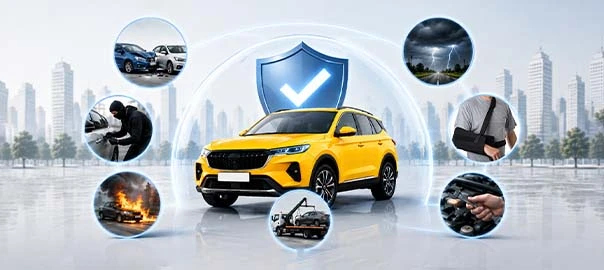
The policy covers you against any loss or damage caused to the vehicle due to the following natural and man-made calamities

02

Natural Calamities

Fire, explosion, self-ignition or lightning, typhoon, hurricane, earthquakes, floods, storms, tempest, inundation, cyclones, hailstorm, frost, landslides or rockslides

03

Man-made Disasters

Riots, strikes, malicious acts, terrorist activities, any violent activities are generally covered as man-made disasters

04

Accidental Damages

Burglary, theft, accidents by external means, any damage in transit by road, rails, inland waterways, lifts, elevators or air

05

Third-Party Personal Liability

The insurance policy provides unlimited coverages, i.e., whatever the court awards as your liability to the third-party due to accidental death or injuries caused by your vehicle

06

Third-Party Property Liability

In case your vehicle causes third-party property damage, the insurer will offer compensation up to Rs. 7,50,000/- for GCCV

01

Accident due to External Factors

Accidental loss or damage to the insured or any person driving with the knowledge and consent of the insured is under the influence of intoxicating liquor or drugs or wilful negligence

02

Vehicles Outside the Defined Territory

Loss or liability while the vehicle is used outside the scope of its limitations of use or being driven by a person not duly licensed

03

Other Accidental Losses

Consequential loss, Depreciation, wear and tear, mechanical and electrical breakdown/failure or breakages will not be covered by Shriram Car Insurance policy

04

Loss due to Nuclear/Radioactive Elements

Loss connected to nuclear or radioactivity or war and related activities is not covered under this policy


Frequently Asked Questions

What are the two types of goods carrying vehicle insurance policies?

  • Third-Party Liability Insurance
  • Comprehensive Insurance

What our customers say ?

4.6

1753+ Customer Ratings

View all
customer

MARCUS MANOHAR PARKHE

Mr. Khalil, your Executive was very coperative. the overall experience was very good. Thank you.

customer

ANIL KUMAR HP

Good

customer

VAISHALI VAIBHAVKUMAR PANDYA

very good

customer

CHAUDHARI JASAVANTKUMAR

Good

customer

AKRAM KHAN

Good

left-arrowright-arrow
Quote

Blogs

How Dashcam Footage Can Help in Faster Car Insurance Claims?

How Dashcam Footage Can Help in Faster Car Insurance Claims

Posted on 2025-12-16 05:34:56

Road rage cases are on the rise in India, with 4,000 reported in 2023 alone. If you ever encounter any such instance that leaves your car damaged, then you will need credible proof that confirms you were not at fault. It can be especially difficult in cases with no eyewitnesses or recorded evidence to prove your innocence. This is where dashcam footage can help innocent drivers. You can use it as strong video evidence to remove confusion about who is responsible for the accident, thereby reducing the need for lengthy investigations. Since this footage captures raw, unedited footage of the accident, insurance companies can quickly establish fault and process claims. In this blog, we’ve shared a detailed explanation of the link between dashcams and car insurance claims. You can use it to speed up your car insurance claim process.

The Role of AI in Car Insurance Claim Approvals

The Role of AI in Car Insurance Claim Approvals

Posted on 2025-12-15 06:26:02

Over 82% of insurance companies now use AI in claim processing, but have you wondered what it means for policyholders like you? Artificial Intelligence (AI) is redesigning the entire claim approval process so policyholders can benefit from faster and more accurate claim-related decisions. AI uses multiple mechanisms to streamline the entire process, from initial claim submission to the final payout. It uses computer vision, machine learning algorithms, etc., to automate the process. It not only reduces manual claim review time and human error, but also ensures faster approval of genuine claims. In this blog, we’ve highlighted AI’s role in car insurance claim approval processes.

The Role of Artificial Intelligence in Next-Gen Car Safety Systems

Posted on 2025-12-12 10:37:40

Artificial Intelligence (AI) is redefining what ‘safe driving’ means by powering next-gen car safety systems. It’s enabling car safety systems to predict, detect, and respond to potential road safety hazards with greater accuracy. Artificial Intelligence (AI) in cars can notably reduce accident instances, making driving experiences more secure. In this blog, you will find the role of AI in automotive safety and how it enhances secure driving experiences.

View all
Quick renewal Quick renewal
bimabharosa
Back to TopBack to top of the pageBack to top of the page

IRDAI Consumer Education:- Insurance is the subject matter of solicitation. IRDAI Registration Number - 137. CIN No. U66010RJ2006PLC029979. BEWARE OF SPURIOUS PHONE CALLS AND FICTITIOUS/FRAUDULENT OFFERS. IRDAI clarifies to public that IRDAI or its officials do not involve in activities like sale of any kind of insurance or financial products nor invest premiums. IRDAI does not announce any bonus. Public receiving such phone calls are requested to lodge a police complaint along with details of phone call, number.

Terms and Conditions |Refund and Cancellation© 2023 Shriram General Insurance. All rights reserved.