


Why Health Insurance Claims Get Rejected Top Reasons And Mistakes
18 July,2026
Updated:30 September,2026
0 min read

share


Copied
 489
489This blog covers the common reasons and mistakes that usually lead to health insurance claim rejections.
Nothing can be as frustrating as seeing a ‘Claim Rejected’ message when you’re in the middle of a health emergency. Unfortunately, many policyholders have had such unpleasant experiences. Some individuals assume that having an active health insurance policy guarantees claim approval, which isn’t always the case.
You can face health insurance claim rejection if you’re making the common mistakes we’ve talked about in this blog. We’ve covered the common reasons, mistakes, and next steps to take, so ensure you read the full blog.
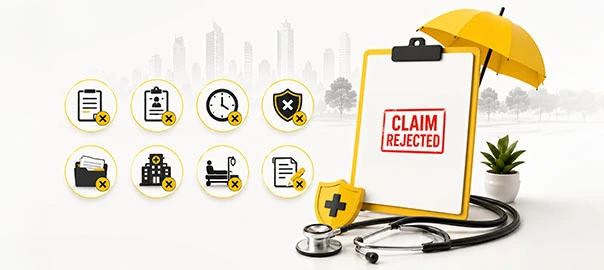
Common Reasons for Claim Rejection
Whether your cashless claim got rejected or you’ve faced multiple mediclaim rejections over the years, it could be for one of the following reasons.
Non-Disclosure/Incorrect Disclosure of Medical Information
It’s one of the most common reasons for health insurance claim rejections. Insurers rely on policyholders to fully disclose any past medical history while purchasing a policy. If you don’t disclose details about your past diseases or treatments, insurers treat it as a breach of trust and policy terms. Even incorrect disclosure amounts to a breach. Both are valid grounds for claim rejection.
Availing Treatment During Waiting Period
Health insurance policies usually come with a waiting period for specific illnesses, pre-existing conditions, or certain medical procedures. You cannot file claims for the listed diseases or treatments during this period. Doing so will lead to rejection.
Submitting Incomplete/Inconsistent Documents
Insurance companies require certain medical records, discharge summaries, bills, prescriptions, and other documents to assess claims. If you share inconsistent or inaccurate documents, insurers can rightfully reject the claim. Missing documents also lead to health claim rejection.
Filing Claims for Excluded Medical Conditions/Treatments
Every health insurance policy comes with its own set of exclusions. If you’ve received treatment for a medical condition that was not part of the policy coverage or received a medical procedure that was not included under the policy’s terms & conditions, you may also face a health insurance claim rejection.
Common Mistakes to Avoid During the Claim Process
You can increase your chances of health insurance claim approval by avoiding the mistakes listed below.
Delaying Intimation to the Insurer
If you or anyone covered under the policy is hospitalised or receives any medical treatment, you should inform the insurer at the earliest. Don’t wait for discharge, as delayed notifications can create procedural complications. Delayed communication and failure to follow procedural steps from the start are among the top reasons for cashless claim rejections.
Failing to Verify Policy Coverage Before Availing Treatment
Another common mistake people make is assuming that every medical expense is covered under the policy. We’d encourage everyone to thoroughly review their policy terms, exclusions, waiting periods, sub-limits, and other coverage conditions before availing themselves of any treatment. This knowledge will ensure you file claims that have a higher chance of approval.
Not Uploading All Key Documents
Your claim approval depends significantly on the accuracy and completeness of the documents submitted with the claim form. Even one missing document can increase your chances of claim rejection. Hence, always try to submit all the documents requested by the insurer. It’s one of the best health insurance claim tips that works every time.
Ignoring Cashless Hospitalisation Procedures
Pay special attention to this point if you’ve recently faced a cashless claim rejection. As a policyholder, you should be aware that you can claim cashless hospitalisation only when you avail yourself of the treatment at a network hospital. There’s a separate insurer authorisation process you must follow; failing to do so will result in the claim being rejected.
How Claim Rejections Impact Policyholders
Whether you’ve faced a regular health claim rejection or a mediclaim rejection, both can have consequences beyond the immediate medical bill. You may have to arrange substantial out-of-pocket funds during an already stressful health emergency. Continued claim rejections can lead to delayed treatments, depletion of savings, and increased financial dependence on loans or third parties. During extremely challenging situations, policyholders may also face emotional and administrative burdens.
Step-by-Step Health Insurance Claim Process
For Non-Cashless Claims
If you want to know the health insurance claim process (non-cashless claims), then follow the steps listed below –
- Start with Early Intimation: Inform the insurer or a third-party administrator at the earliest. If you’ve had an emergency, try to inform them within 24 hours or at least 48 hours before planned hospitalisation.
- Pay Upfront & Collect Necessary Documents: Settle the hospital bill in full at discharge and collect all key original documents. You should keep every hospital bill, payment receipt, doctor prescriptions, etc.
- Submit Claim Form: Visit your insurer’s website and file the claim request. Submit the claim form and upload all the original documents for verification.
- Wait for Verification & Refund: Once the insurer’s team has verified and approved all the documents, they’ll initiate the reimbursement to your registered bank account. There is no standard verification period, so you can track the claim status on the insurer’s website every week.
For Cashless Claims
People exploring the cashless health insurance claim process should follow the steps below.
- Inform the insurer at the earliest.
- Visit an approved network hospital and present your health insurance card and any other details the hospital may request.
- The network will share a pre-authorisation form with your insurer. Once it’s approved, you can avail the cashless claim facility.
However, you will still have to pay for expenses not covered by the policy.
Documentation Requirements for Health Insurance Claim Approvals
You will have to submit numerous key documents to get your health insurance claim approved. Although the precise list of documents may vary from one hospital to another, or depend on the claim amount, treatment type, case severity, etc., you should generally be ready with the following documents –
| Category | Required Documents |
|---|---|
| Policy & Identification | Duly filled claim form, KYC documents (PAN, Aadhaar card, passport, etc.), A copy of your health insurance policy/policy number, Health insurance ID card |
| Hospital Records | Hospital admission records, Discharge summary, Diagnostic & laboratory reports |
| Medical & Consultation | Doctor’s prescriptions, Consultation notes, Pharmacy bills |
| Billing & Payment | Original hospital bills and payment receipts, Itemised hospital bill (breakdown of charges), Bank account details or a cancelled cheque for reimbursement claims |
What is a Waiting Period Clause?
Anyone who fails to understand why their mediclaim fails or what could be the reason(s) for a cashless claim rejection should gain a thorough understanding of their policy’s waiting period clause. It’s something many policyholders miss, leading to frequent claim rejections.
A waiting period clause is a provision in a health insurance policy that requires policyholders to wait for a specific period before certain illnesses or treatments can become eligible for coverage. Even though the policy remains active throughout the waiting period, claims related to those specific conditions may not be payable. Waiting periods usually apply to pre-existing diseases, specified illnesses, maternity benefits, and certain medical procedures. They vary from one insurer to another and from one policy to another, so we recommend checking your policy-specific waiting period details. If you’re confused, contact the insurer’s customer support team for guidance.
Consequences of Hiding Medical History
Intentionally withholding certain medical information about the people covered under the policy can have serious consequences. We’ve covered some of the key consequences that policyholders usually face in such cases.
Claim Rejection During Medical Investigation
When you file a claim request, the insurer will first review the medical records, hospital documents, and treatment history for verification. If they find any undisclosed medical condition or any other key health-related information that was not shared during policy purchase, they may instantly reject the claim.
Policy Cancellation/Termination
In serious cases, the insurer may cancel or terminate the policy altogether. If the policyholder has deliberately withheld key medical history details, then the insurer is likely to cancel/terminate the policy.
Financial Burden During Medical Emergencies
Hiding medical history usually leads to a health claim rejection. In such cases, you will need to cover the entire medical expense yourself. If you or someone covered in the policy gets hospitalised, a claim rejection may lead to severe financial strain. It may force policyholders to exhaust their savings or liquidate their investments.
Importance of Renewing Health Policies on Time
As a policyholder, you should always renew your health policies on time. Missing a premium payment, even after the grace period, can leave you and your family uninsured during health emergencies. You may also lose continuity of benefits and coverage for pre-existing conditions. With timely renewal, you can continue availing the coverage benefits.
What to do if a Health Insurance Claim is Rejected?
Health insurance claims can get rejected for several reasons. If your claim is rejected, you can take the following steps.
- Review the Rejection Letter: Insurers don’t randomly cancel any claim. They will always share the reason for their rejection, so carefully review the details to determine what went wrong. It will help you decide the next best step.
- Seek Clarification from the Insurer: If the cashless claim rejection reasons or mediclaim rejection reasons seem unclear, you can contact the insurer for clarification. Occasionally a dispute can arise due to a misunderstanding. A clarification can help resolve it.
- Submit Additional Documents (If Needed): Insufficient documents usually lead to a rejection of a health insurance claim. If your claim was rejected for a similar reason, ask the insurer about missing documents and submit them on time. You can then request a re-evaluation of the decision.
- Use the Insurer’s Grievance Redressal System: Every insurance company has an internal grievance redressal process. If you believe the claim rejection was unfair, you can use it to lodge a formal complaint. Ensure you submit all supporting documents to strengthen your case. Even if this step doesn’t work, you can consider escalating the matter to higher authorities.
Conclusion
Policyholders rely on health insurance claims during a medical emergency. A rejection in such cases can put them under extreme financial and emotional burden. If you don’t want your regular health or cashless claim to get rejected, ensure you don’t make the mistakes covered in this blog. We’ve also shared the key reasons for health insurance claim rejections so you don’t repeat them. If you’re looking for a dependable health insurance provider with strong grievance-checking systems for policyholders, consider Shriram General Insurance.
FAQs
1. Can a health insurance claim get rejected even if premiums are paid on time?
Yes, even if you’ve made timely premium payments, your claim can get rejected for several reasons. Common reasons for claim rejection include not disclosing the full medical history or submitting incomplete documents.
2. Do all companies have the same waiting period?
No, different companies have their own waiting period duration and clause. We’d suggest exploring the waiting period specific to your insurer or policy.
3. Can I appeal a rejected health insurance claim?
Yes, you can. All insurance companies have an internal grievance redressal system for their policyholders. You can use it to challenge the decision.
4. Do insurers verify medical history during claim settlement?
Yes, they do. In fact, the decision to approve or reject a claim depends on the medical history you’ve shared with the insurer.
5. What documents do I need for health insurance claim approval?
You’ll require all the documents related to diagnostics, treatment, hospitalisation, and discharge. Since the list varies by insurer, we’d recommend checking your insurer’s website for the full list of documents.